

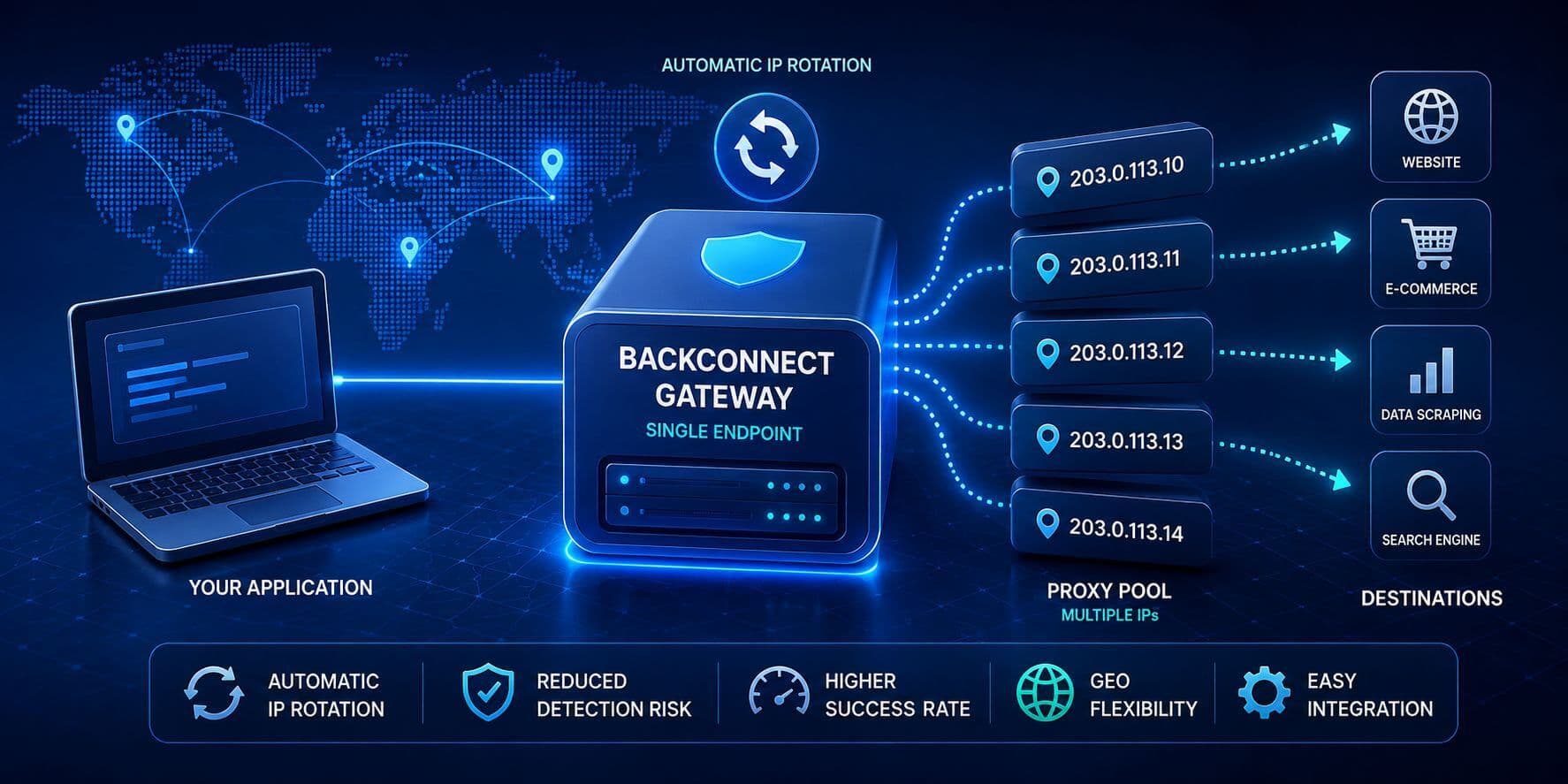
Rotating proxies and backconnect gateways are often discussed as if they were separate proxy types. They are not.
A rotating proxy describes how the outbound IP address changes over time. A backconnect gateway describes how that rotation is delivered to the application.
The simplest distinction is:
This architecture can simplify scraping, monitoring, testing, and other automated workloads because applications no longer need to maintain and rotate large lists of individual proxy endpoints.
However, managed rotation is not automatically better than direct proxy-pool control.
The right model depends on:
This guide explains how rotating proxies and backconnect gateways work, where they differ, and when each approach makes sense.
A rotating proxy system changes the outbound proxy IP used by an application according to defined rules.
Instead of routing every request through one static address, traffic is distributed across a larger proxy pool.
A basic flow might look like:
Request 1 → Proxy A
Request 2 → Proxy B
Request 3 → Proxy C
Request 4 → Proxy D
Rotation can happen:
The purpose of rotation is not simply to change IP addresses as frequently as possible.
In production systems, rotation is primarily used to:
For a deeper explanation of the underlying mechanics, see the guide to IP rotation and proxy assignment.
A backconnect proxy is a gateway that sits between the application and a larger underlying proxy pool.
Instead of connecting to individual proxies such as:
192.0.2.10:8000
192.0.2.11:8000
192.0.2.12:8000
the application connects to one endpoint:
gateway.example.com:8000
The gateway then decides which underlying proxy should handle the request.
The architecture looks like:
Application
    ↓
Backconnect Gateway
    ↓
Proxy Selection Layer
    ↓
Proxy Pool
    ↓
Destination
The underlying pool may contain:
This is an important distinction.
Backconnect describes the routing architecture, not the type of IP being used.
A typical backconnect service performs several functions behind one endpoint.
The application authenticates using:
The gateway selects an outbound IP based on rules such as:
The provider decides when the exit IP changes.
This may happen:
Some gateways remove unavailable or degraded proxies automatically.
This reduces the amount of proxy health management that application teams must implement themselves.
Sticky-session systems associate a session identifier with a particular exit IP.
For example:
session=abc123 → Proxy 45
session=xyz789 → Proxy 87
As long as the session remains valid and the proxy remains available, subsequent requests can continue through the same address.
The fundamental difference is who manages proxy allocation.
| Capability | Direct Rotating Pool | Backconnect Gateway |
|---|---|---|
| Application sees individual IPs | Yes | Usually no |
| Proxy selection | Customer | Provider |
| Health checks | Customer | Often provider |
| Rotation logic | Customer | Provider |
| Session handling | Customer-defined | Usually parameter-based |
| Pool transparency | Higher | Lower |
| Integration complexity | Higher | Lower |
| Custom routing | Excellent | Provider-dependent |
| Operational overhead | Higher | Lower |
A direct pool gives the engineering team more control.
A backconnect gateway provides more abstraction.
Neither is inherently superior.
The choice depends on whether the workload values control or operational simplicity.
Backconnect gateways and self-managed proxy pools can support similar rotation models.
Each request can use a different outbound IP.
Example:
Request A → IP 1
Request B → IP 2
Request C → IP 3
This works well for:
It is less suitable for workflows that depend on session continuity.
A sticky session keeps one IP assigned to a logical session.
Example:
Session A
  ├── Request 1 → Proxy 18
  ├── Request 2 → Proxy 18
  └── Request 3 → Proxy 18
Sticky sessions are useful for:
The correct sticky duration depends on the workflow rather than a universal rule.
The gateway changes the proxy after a configured interval.
For example:
Proxy A → 10 minutes
Proxy B → next 10 minutes
Proxy C → next 10 minutes
This can be useful for recurring monitoring and continuous collection.
A more advanced system rotates away from proxies that begin generating:
Health-aware rotation is often more useful than purely random rotation because it incorporates actual proxy performance.
A common misconception is that automatic proxy rotation makes request management unnecessary.
It does not.
A backconnect gateway can change outbound IPs, but it does not automatically fix:
For example, if a target returns HTTP 429 because a workload is sending too many requests, cycling through additional IPs while keeping the same request pressure may simply spread the problem across a larger network.
Proxy rotation should be combined with:
Managed backconnect infrastructure is particularly useful when operational simplicity matters.
Applications can often integrate one endpoint rather than loading and maintaining thousands of individual proxy addresses.
This can reduce integration time considerably.
Backconnect gateways are useful when the underlying network contains far more addresses than an application would reasonably manage directly.
This is especially common with residential proxy services.
If many crawler workers or servers need proxy access, one gateway can centralize routing.
For example:
Worker A ─┐
Worker B ─┼→ Backconnect Gateway → Proxy Pool
Worker C ─┘
The workers do not need synchronized copies of the underlying proxy inventory.
Managed gateways commonly expose location parameters.
Depending on the provider, applications may request routing by:
This can simplify geographically distributed testing or data collection.
Teams that do not want to build:
may prefer provider-managed infrastructure.
For high-volume collection, this can reduce some of the operational complexity associated with large-scale proxy-backed scraping.
Backconnect abstraction has trade-offs.
Teams may prefer direct access to individual proxies when they need more detailed infrastructure control.
A self-managed pool allows teams to track:
A managed gateway may expose less detail about individual exit nodes.
Applications can design their own health models.
For example:
Success rate:      50%
Latency score:     20%
Recent failures:   20%
Current load:      10%
This gives engineering teams direct control over routing.
Some workloads require specific IPs to remain assigned to specific systems.
Static or dedicated proxy pools are better suited to those requirements.
An internal proxy manager can assign:
This level of routing may be difficult to reproduce through a simplified commercial gateway.
Teams needing this degree of control can implement proxy rotation and pool management directly in their own infrastructure.
Backconnect gateways and static proxies solve different problems.
One assigned IP remains stable.
Useful when applications need:
One gateway gives access to multiple changing IPs.
Useful when applications need:
The key decision is whether the workload benefits more from identity persistence or IP distribution.
The broader comparison of fixed IPs versus rotating proxies covers that trade-off in more detail.
A backconnect gateway resembles a load balancer conceptually, but the objectives differ.
A traditional load balancer distributes incoming traffic across application servers.
A backconnect gateway distributes outbound traffic across proxy exits.
Conceptually:
Load Balancer:
User → Gateway → Application Servers

Backconnect Gateway:
Application → Gateway → Proxy Servers
Both abstract a pool of underlying resources behind one endpoint.
This is why backconnect gateways are useful in distributed automation architecture.
Backconnect gateways are strongly associated with residential proxy products because residential networks can contain extremely large and dynamic IP inventories.
Maintaining an explicit list of millions of residential endpoints would be impractical.
Instead, applications connect through a gateway such as:
residential.example.com:9000
and specify parameters for:
The gateway handles which residential node is used.
However, the architecture is equally applicable to datacenter and ISP proxy networks.
Datacenter proxy providers can also place a rotating gateway in front of a static inventory.
For example:
Datacenter Pool
├── IP 1
├── IP 2
├── IP 3
├── IP 4
└── IP 5
       ↑
   Gateway
This gives applications the convenience of a single endpoint while preserving the throughput and economics of datacenter infrastructure.
For organizations operating their own large pools, the same concept can be implemented internally using a proxy allocator or proxy-management service.
Session handling is one of the most important features to evaluate.
Suppose a workflow contains:
Login
  ↓
Search
  ↓
Open Product
  ↓
Add to Cart
If every request uses a different IP, the destination may see one session appearing from several unrelated networks.
That can cause:
A sticky backconnect session keeps the same IP during the workflow.
For example:
session=customer123
        ↓
Backconnect Gateway
        ↓
Proxy 42
All requests containing the same session parameter continue through Proxy 42 while the session remains valid.
Teams should verify:
Rotation and retries should not be treated as the same operation.
When a request fails, first classify why.
Usually indicates rate limiting.
Potential response:
Retry-After;Changing IPs immediately may not address the underlying problem.
Possible causes include:
Changing proxies may help in some cases, but diagnosis should come first.
A server-side error may have nothing to do with the proxy.
Rotating through multiple addresses in response to a temporary 500 can waste bandwidth and proxy capacity.
A repeated connection problem associated with one exit node may justify retrying through another proxy.
A resilient system uses:
failure classification → retry policy → rotation decision
rather than:
failure → always rotate
Even when a provider manages individual proxy health, customers still need workload-level telemetry.
Track at least:
If the gateway supports geographic routing, also monitor performance by:
A managed gateway should reduce infrastructure maintenance, not eliminate monitoring.
Backconnect infrastructure may be priced in several ways.
Common with residential networks.
Cost is based on transferred traffic.
This makes bandwidth efficiency important.
Some services charge according to the number of requests processed.
Some datacenter or ISP gateways are tied to a fixed proxy inventory.
Pricing may depend on:
When comparing providers, do not evaluate only the advertised unit price.
Calculate:
Total proxy cost ÷ successful requests
A more complete version is:
Total infrastructure cost = proxy charges + bandwidth + retries + compute + engineering overhead
Backconnect infrastructure is financially justified when the reduction in engineering complexity or failure cost outweighs any premium charged for managed routing.
Automatic rotation can make inefficient systems harder to notice.
For example, imagine a crawler that sends 10 million requests but only needs 6 million because:
A rotating gateway may successfully distribute that unnecessary workload across thousands of IPs.
Technically, the proxy network performs well.
Economically, the crawler is inefficient.
Managed rotation should therefore be paired with:
A mature architecture might look like:
                        Job Queue
                            ↓
                     Crawler Workers
                            ↓
                       Proxy Layer
                  ┌─────────┴─────────┐
                  ↓                   ↓
          Backconnect Gateway   Direct Proxy Pool
                  ↓                   ↓
          Managed Rotation      Internal Rotation
                  └─────────┬─────────┘
                            ↓
                       Target Sites
                            ↓
                       Validation
                            ↓
                    Metrics / Feedback
The proxy layer can choose the appropriate route according to:
This hybrid model provides both convenience and control.
Many organizations eventually use both managed gateways and self-managed pools.
For example:
Use for:
Use for:
Use for:
The proxy architecture should follow the workload instead of forcing every job through one routing model.
Use this decision framework.
False.
Backconnect describes the gateway architecture. The underlying addresses can be residential, datacenter, ISP, or another network type.
Not quite.
Rotation describes the behavior of changing IPs.
Backconnect describes how the application accesses the rotating pool.
A system can rotate proxies without using a backconnect gateway.
False.
They distribute traffic but do not remove the need for rate control, appropriate access, session management, and responsible request behavior.
False.
The provider may monitor proxy nodes, but customers still need to monitor application-level success and data quality.
False.
Excessive rotation can break sessions, create inconsistent localization, and make troubleshooting more difficult.
Before choosing a service, verify:
A backconnect proxy is a gateway that routes application traffic through a larger underlying proxy pool. The application connects to one endpoint while the gateway selects and rotates outbound proxy IPs.
Not exactly. A rotating proxy system changes outbound IP addresses. A backconnect gateway is one way to provide access to that rotating pool through a single endpoint.
No. Backconnect gateways can route traffic through residential, datacenter, ISP, or other proxy networks.
Rotation depends on the provider and configuration. It may occur for every request, after a connection closes, after a set period, or when a session expires.
Many can. A session identifier can temporarily map multiple requests to the same exit IP. Maximum session duration varies between services.
They can make large rotating networks easier to integrate, but they are not universally better. Teams needing detailed IP-level control may prefer a directly managed proxy pool.
No. They can distribute requests across more addresses, but access restrictions depend on many factors including request behavior, target policies, session management, and IP reputation.
Sometimes. Managed rotation can carry a premium, particularly with residential networks. Compare total operating cost and cost per successful request rather than gateway price alone.
Yes. Organizations with their own proxy inventory can build an internal gateway that performs proxy selection, health checking, session mapping, and routing.
A proxy list exposes individual addresses that the application selects directly. A backconnect endpoint hides the underlying pool behind one gateway and manages selection on behalf of the application.
Rotating proxies and backconnect gateways solve related but different infrastructure problems.
Rotation determines how outbound IPs are changed. A backconnect gateway determines how applications access and manage that rotating pool.
Backconnect gateways are most valuable when:
Direct proxy pools are more appropriate when teams need:
The best production architecture may combine both.
Use inexpensive direct proxy pools for predictable workloads, managed gateways where their abstraction provides real operational value, and static proxies where session identity must remain stable.
Whichever architecture you choose, evaluate it using successful-request rate, session reliability, latency, observability, and total cost per successful outcome, not simply how frequently the proxy IP changes.
Ed Smith is a technical researcher and content strategist at ProxiesThatWork, specializing in web data extraction, proxy infrastructure, and automation frameworks. With years of hands-on experience testing scraping tools, rotating proxy networks, and anti-bot bypass techniques, Ed creates clear, actionable guides that help developers build reliable, compliant, and scalable data pipelines.