


Updated November 10, 2026. Prices and reliability figures checked November 10, 2026.
Most cheap proxy providers say "99.9% uptime" and show nothing behind it. This list ranks seven budget providers by what you can verify before you pay: status-page history, published test results, and independent benchmark data. Webshare and IPRoyal publish the most. ProxyScrape has a perfect, if short, independent record. ProxiesThatWork is the cheapest per IP and the only provider here that publishes per-website test results.
| Rank | Provider | Transparency score (0–4) | Status page history | Published test data | Independent DC reliability (typical month) | Datacenter entry price | Best for |
|---|---|---|---|---|---|---|---|
| 1 | Webshare | 3 | Uptime % | No | 99.0% | $2.99 for 100 IPs | Testing free, then scaling cheaply |
| 2 | IPRoyal | 3 | Uptime % + dated incidents | No | 99.6% | $1.39/IP (90-day plan) | Tracking incidents by region |
| 3 | ProxiesThatWork | 2 | History bars | Yes, per site | Not benchmarked yet | $3 for 150 IPs | Lowest cost per IP |
| 4 | ProxyScrape | 2 | None linked | No | 100.0% (2 months tracked) | $25 for 1,000 IPs + 250 GB | Jobs that can't miss requests |
| 5 | PlainProxies | 2 | Uptime % | No | 98.6% | €27 for 1,000 IPs + 1 TB | Large datacenter pools |
| 6 | InstantProxies | 1 | Uptime % | No | Not benchmarked | $1/IP, from $5/month | Testing your exact target |
| 7 | DataImpulse | 1 | None linked | No | 98.6% | $0.50/GB ($5 for 10 GB) | Pay-as-you-go workloads |
Independent reliability is the "usual month" for datacenter proxies from the benchmark described below, December 2025 to November 2026. Prices are from each provider's own pricing page, checked November 10, 2026.
We ranked providers by how much reliability data you can check before you pay. Price per IP breaks ties. Speed and pool size were not scored.
Budget filter. Every provider here sells datacenter proxies for $1.50 per IP or less, or $1 per GB or less.
Transparency score. Each provider earns one point for each of these:
What "reliability" means here. The benchmark defines reliability as "the share of requests that complete successfully." This is closer to a success rate than to uptime. A proxy can be "up" and still fail requests.
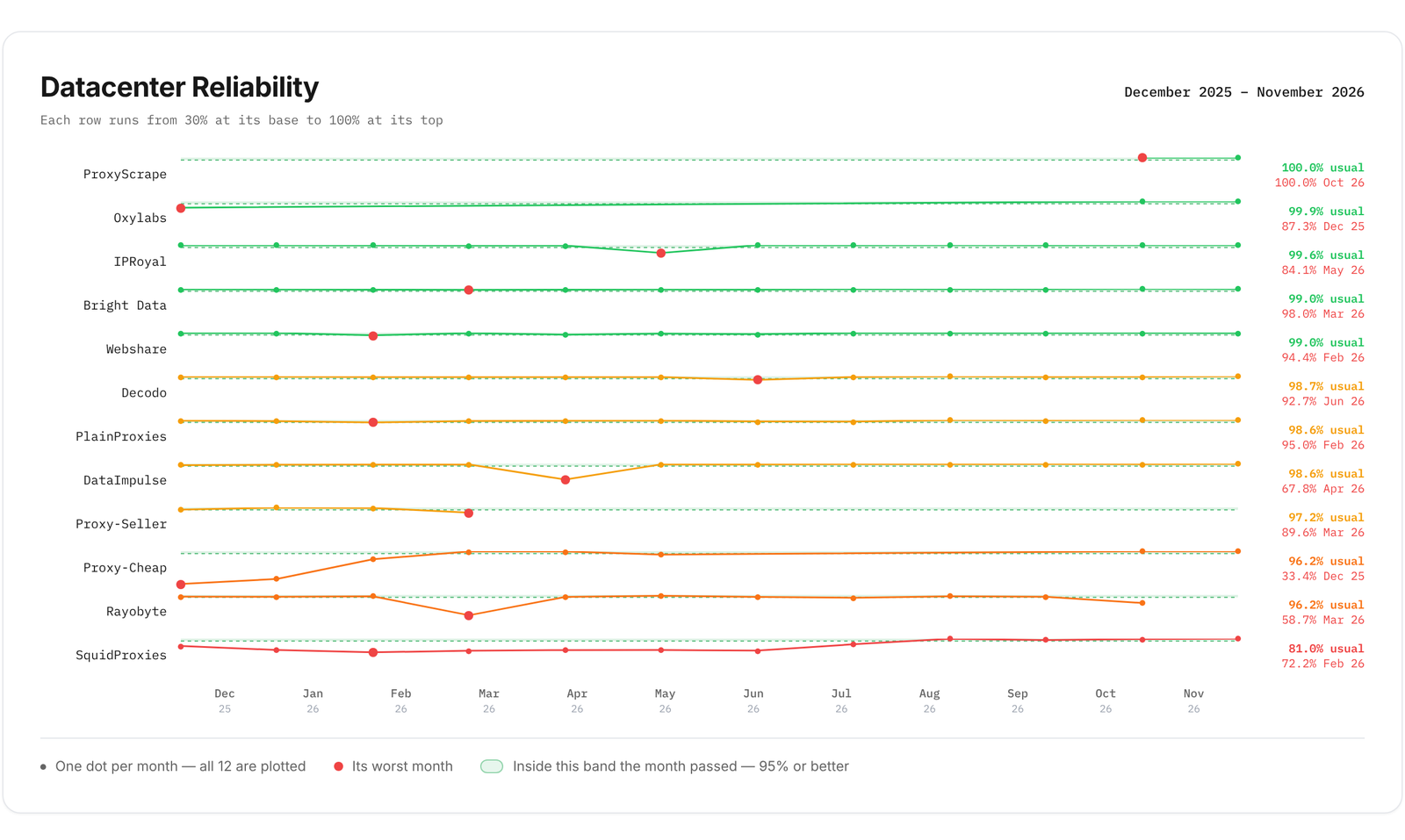
ProxyPerf's datacenter reliability benchmark, December 2025 to November 2026. Each row shows a provider's usual month and its worst month. Captured November 10, 2026.
Disclosure. ProxiesThatWork publishes this list and appears in it. We scored it by the same rules as everyone else.
Best for: testing for free, then scaling cheaply.
Webshare publishes a measured number, not just a promise. Its status page at status.webshare.io shows 98.34% uptime for its proxy servers from August to November 2026. Its help center sets a target of 99.98%, so you can see the gap yourself. The independent benchmark also tracks it.
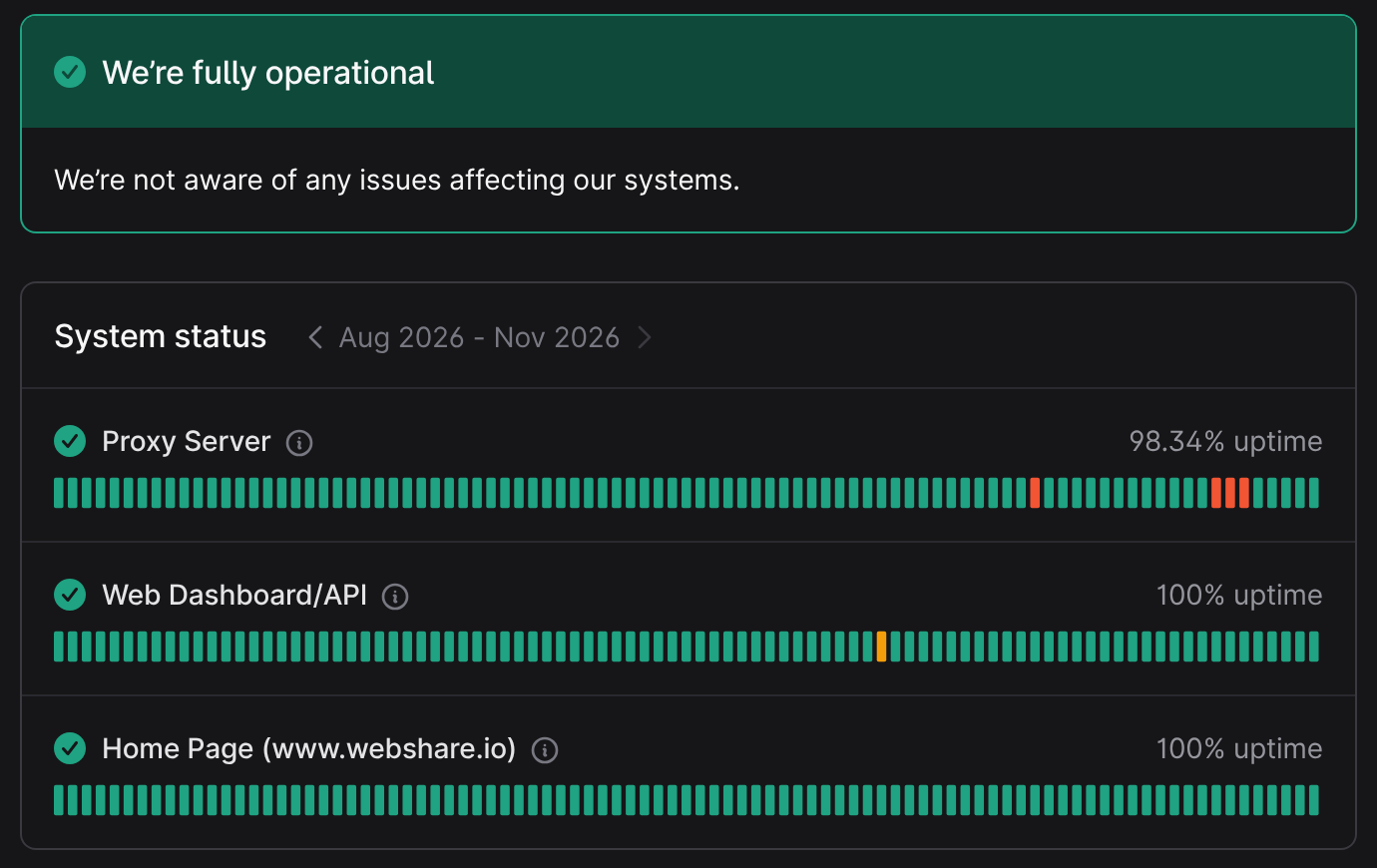
Webshare's status page: 98.34% proxy server uptime, August to November 2026. Captured November 10, 2026.
Pros
Cons
Pricing (checked Nov 10, 2026): $2.99/month for 100 shared datacenter proxies with 250 GB. Residential from $3.50/GB at 1 GB, falling to $1.40/GB at 3,000 GB.
Best for: teams that need to see incidents by region and product.
IPRoyal has the most detailed status page on this list. status.iproyal.com tracks 29 components, such as "North America DC" and "Residential Proxies US." Each component shows its uptime over the past 90 days, such as 98.04% for North America DC. It also lists dated incidents, including a partial residential outage on November 3, 2026. The independent benchmark also tracks it.
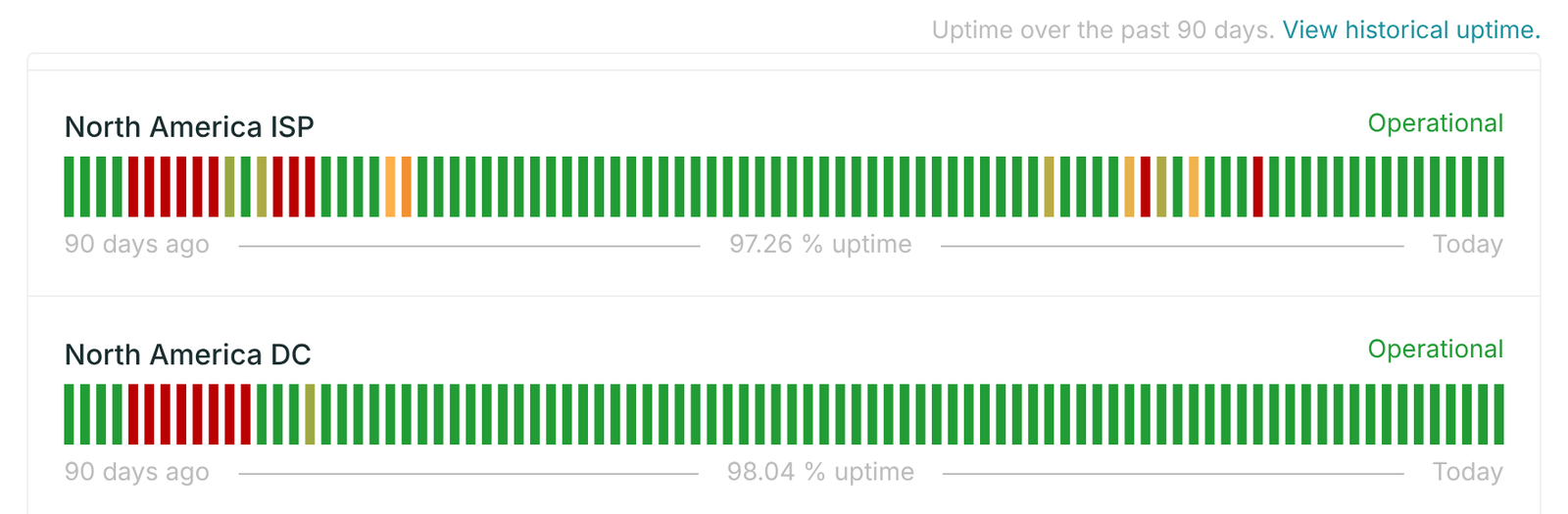
IPRoyal's status page: 90-day uptime per component, including 98.04% for North America DC. Captured November 10, 2026.
Pros
Cons
Pricing (checked Nov 10, 2026): datacenter from $1.57/proxy on 30-day plans, or $1.39/proxy on 90-day plans. Residential from $1.75/GB.
Best for: the lowest cost per IP, with site-level proof before you buy.
ProxiesThatWork is the only provider here that publishes a per-website test result. It tests its network against real websites every 5 minutes. The compatible websites page lists each site with a "Working" status and the time of its last test. The independent benchmark doesn't cover it yet, so it has no independent score.
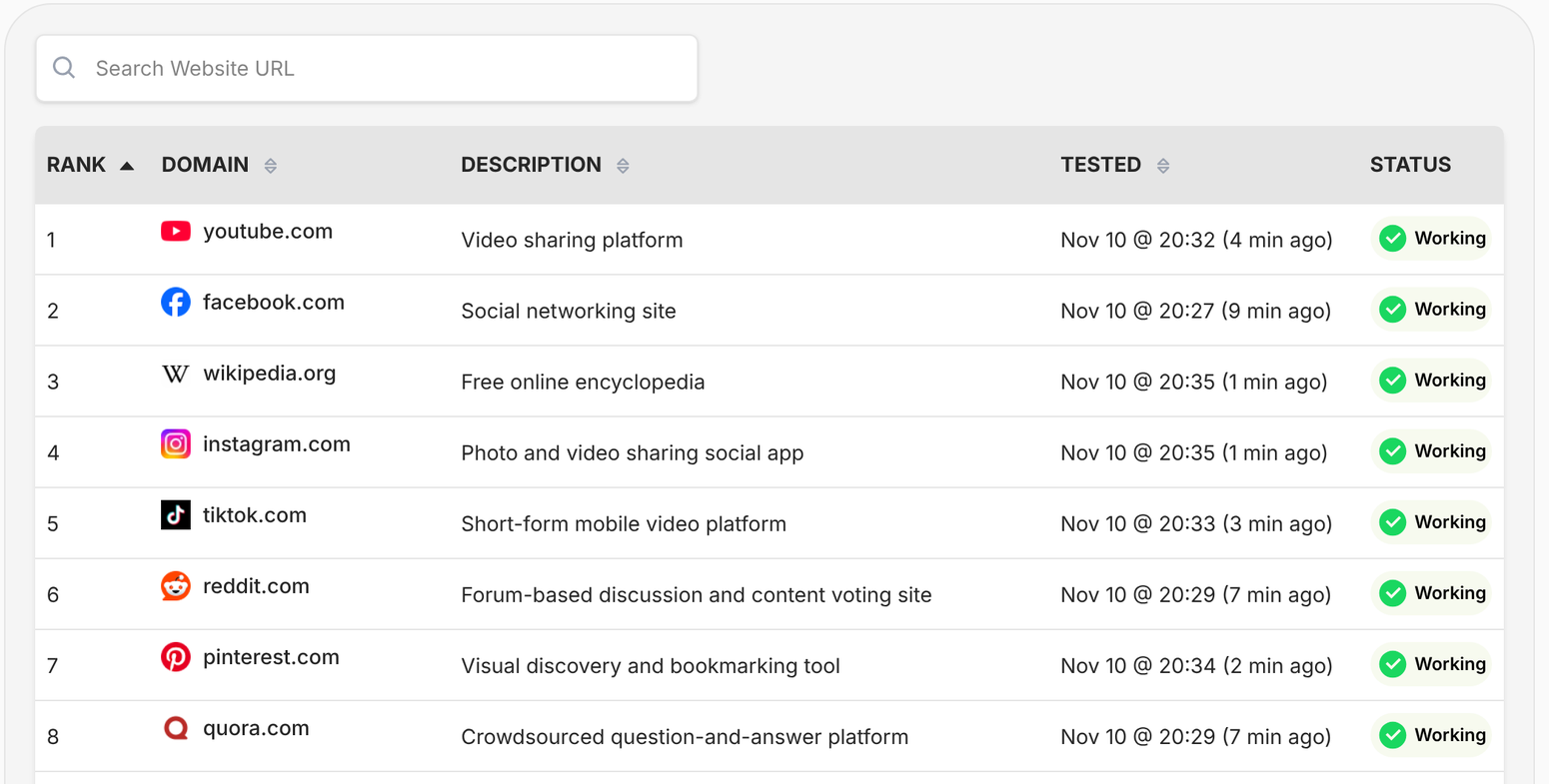
ProxiesThatWork's compatible websites page: each site shows its last test time and status. Captured November 10, 2026.
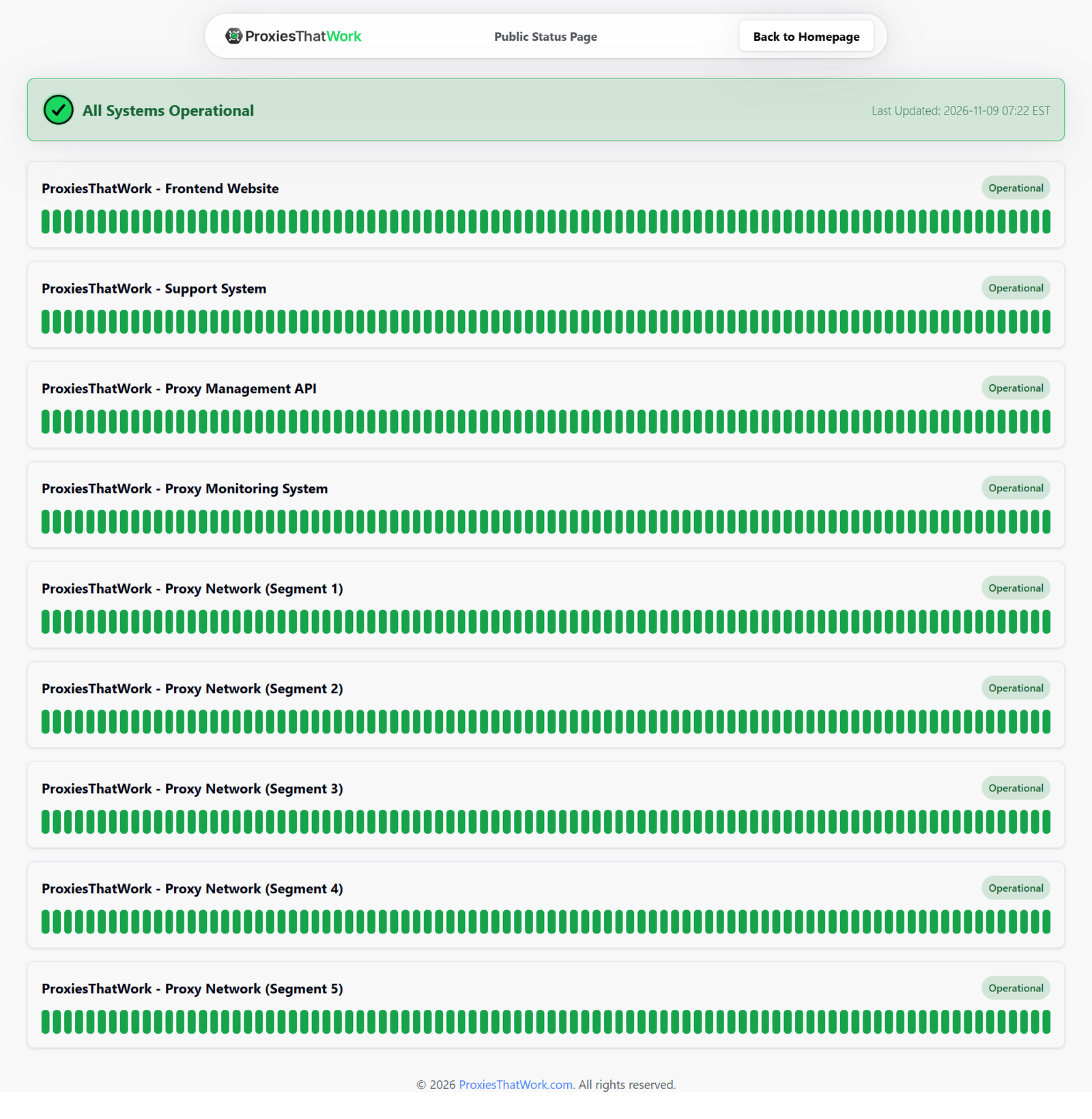
ProxiesThatWork's status page: a history bar for each of 9 components, with no percentages or dates. Captured November 9, 2026.
Pros
Cons
Pricing (checked Nov 10, 2026): $3/month for 150 proxies, $20/month for 1,000, or $50/month for 2,500. All plans are $0.02 per proxy.
Best for: jobs that can't afford missed requests.
ProxyScrape has a perfect but short independent record. The benchmark has tracked its datacenter proxies since October 2026, and both months came in at 100.0%. Its site links no public status page, so it can't climb higher on this list.
Pros
Cons
Pricing (checked Nov 10, 2026): Premium (shared) datacenter from $25/month for a 1,000-IP pool with 250 GB. Larger pools go up to 40,000 IPs, with 1 TB, 5 TB or unlimited bandwidth. Fair usage limits apply.
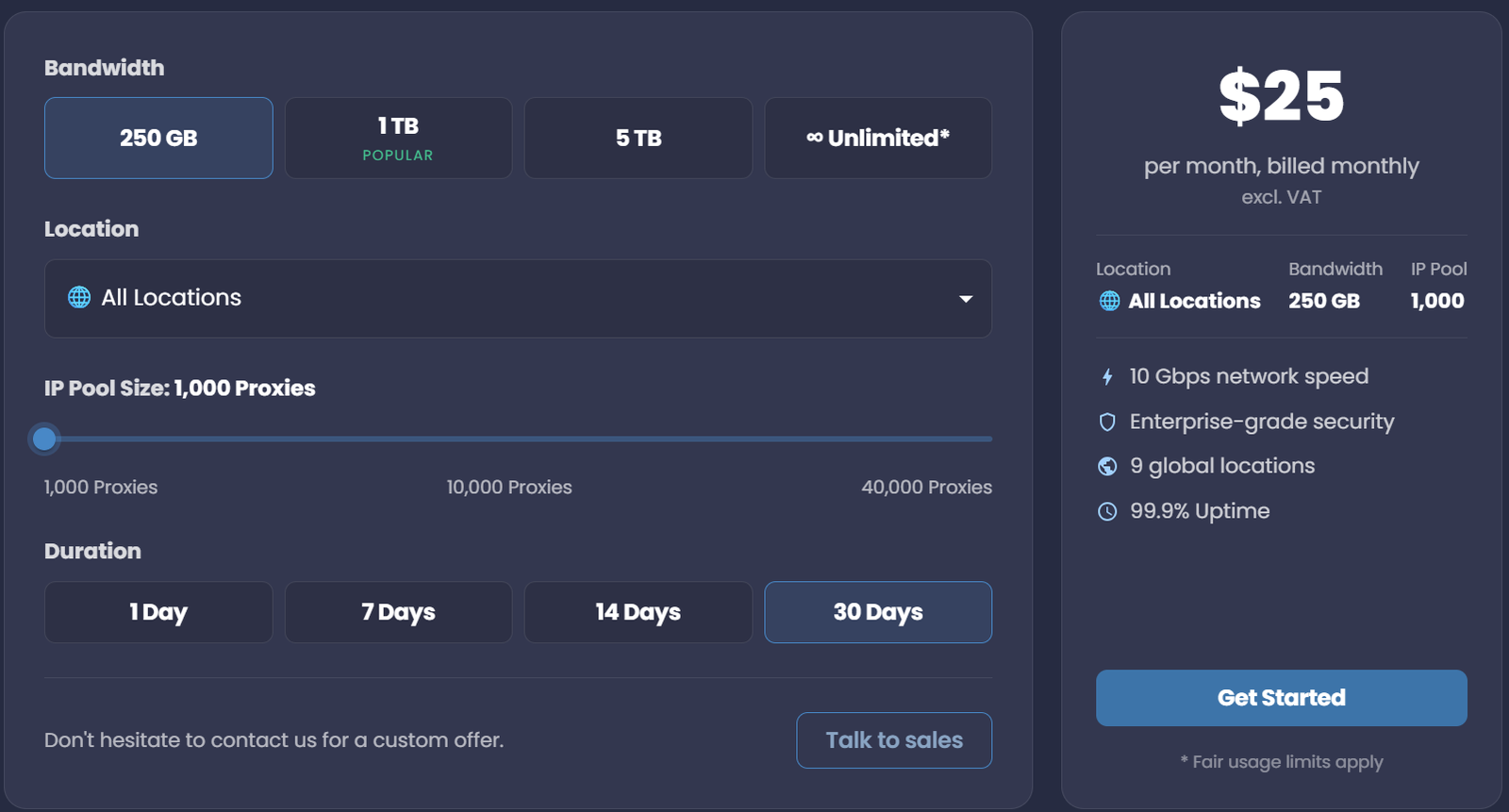
ProxyScrape's Premium Datacenter pricing: $25/month for a 1,000-IP pool with 250 GB. Captured November 10, 2026.
Best for: large datacenter pools on a small budget.
PlainProxies runs a status page at status.plainproxies.com that shows 100% uptime over the last 90 days. That page covers its website and its residential proxies, not its datacenter product. The benchmark puts its datacenter proxies just under the 99% line.
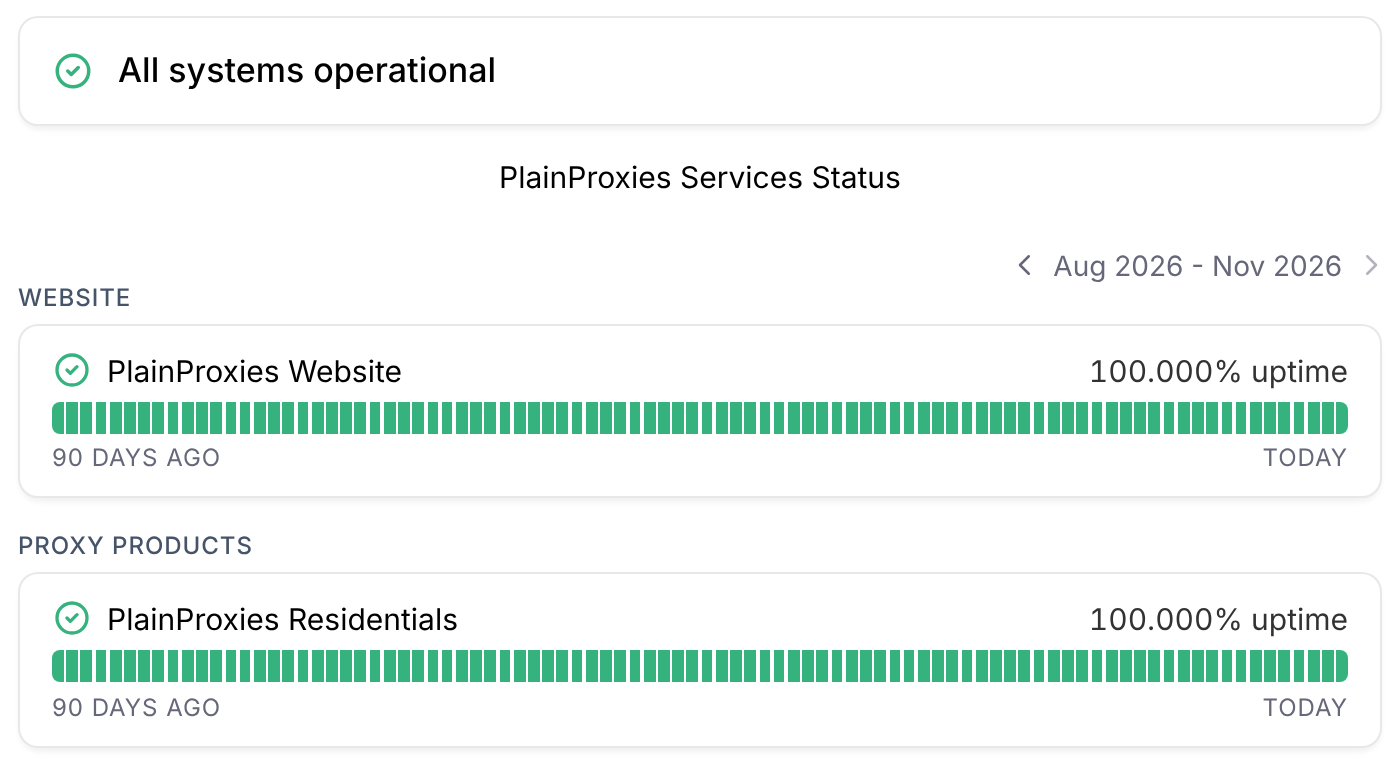
PlainProxies' status page covers its website and residential proxies, not datacenter. Captured November 10, 2026.
Pros
Cons
Pricing (checked Nov 10, 2026): €27/month for 1,000 datacenter IPs with 1 TB of bandwidth. Other pool and bandwidth sizes are available.
Best for: testing your exact target site before you buy.
InstantProxies lets you run a live proxy test against your own URL before purchase. Its status page at status.instantproxies.com shows 100.00% uptime over the last 90 days across 8 components, including 4 proxy network segments. The independent benchmark doesn't cover it.
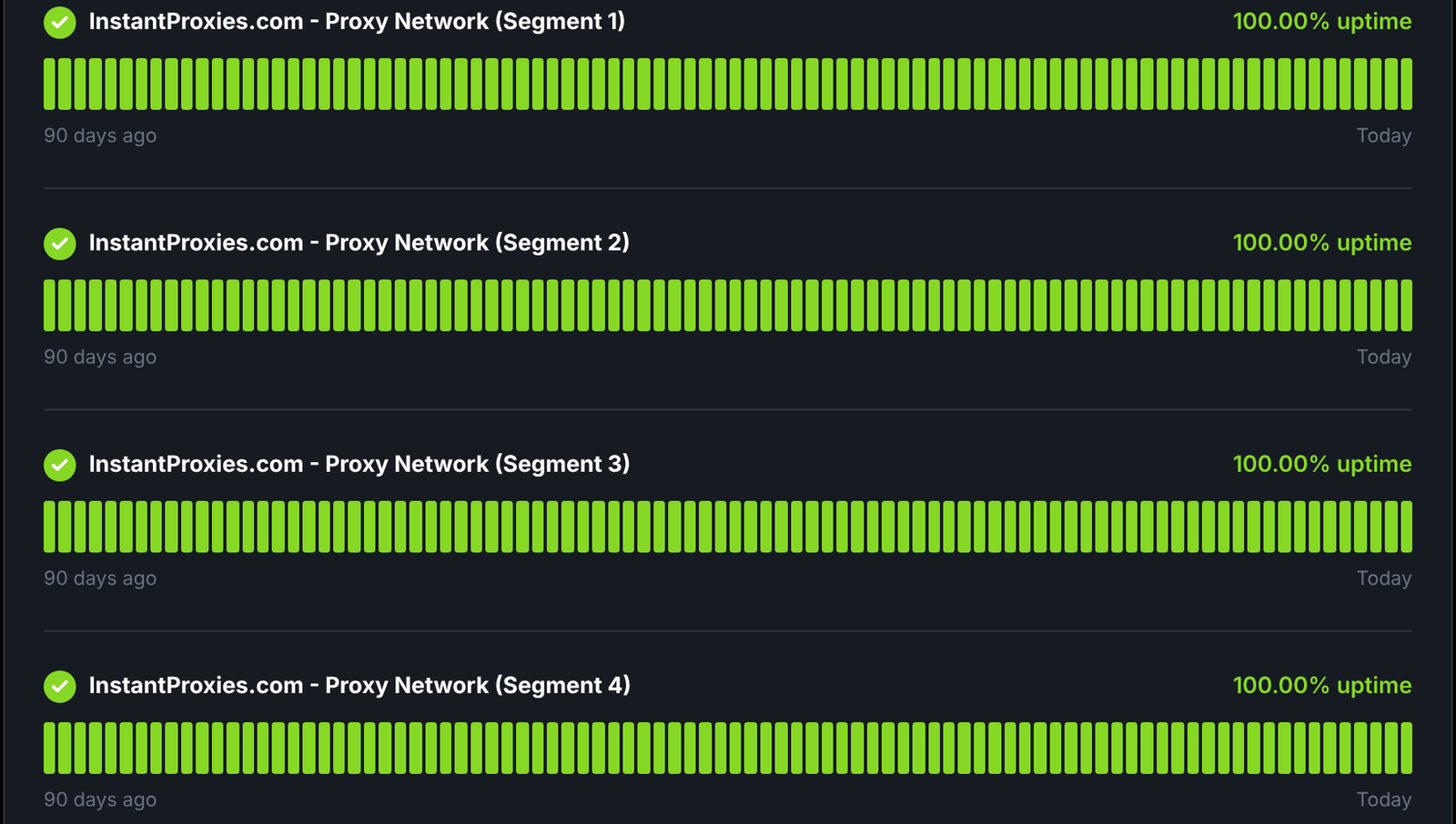
InstantProxies' status page: 90-day uptime for each proxy network segment. Captured November 10, 2026.
Pros
Cons
Pricing (checked Nov 10, 2026): $1 per datacenter proxy, from $5/month. Residential $1/GB.
Best for: irregular or seasonal workloads.
DataImpulse is covered by the independent benchmark, but its site links no status page. Its strength is pay-as-you-go traffic that never expires.
Pros
Cons
Pricing (checked Nov 10, 2026): datacenter $0.50/GB ($5 for 10 GB, $50 for 100 GB), or $0.45/GB at 1 TB. Residential $1/GB.
Pick the provider whose published data covers your target. A 99.9% uptime claim says nothing about whether one specific site blocks you.
Uptime measures whether a proxy server responds. Success rate measures whether your request completes without a timeout, block or error. A proxy can have 100% uptime and still fail requests on a protected site. For scraping and monitoring, success rate matters more.
IPRoyal has the strongest 12-month record here. The independent benchmark measured 99.6% datacenter reliability in a typical month from December 2025 to November 2026. ProxyScrape scored 100.0% in both months it has been tracked, October and November 2026, which is too short to compare fully.
Status pages show what the provider chooses to report. Some show uptime history, some show dated incidents, and some show only current status. None show blocks on specific sites. Use them alongside independent benchmarks or your own tests.
ProxiesThatWork costs $0.02 per IP. It publishes a "Working" status for 1,000+ websites, retested every 5 minutes. These results are self-reported, not independently verified.
Send 50–100 requests through the proxy to your real target. Count the responses that return status 200 with the content you expect. Divide by the total. Repeat at different times of day.
Nicholas Drake is a seasoned technology writer and data privacy advocate at ProxiesThatWork.com. With a background in cybersecurity and years of hands-on experience in proxy infrastructure, web scraping, and anonymous browsing, Nicholas specializes in breaking down complex technical topics into clear, actionable insights. Whether he's demystifying proxy errors or testing the latest scraping tools, his mission is to help developers, researchers, and digital professionals navigate the web securely and efficiently.