

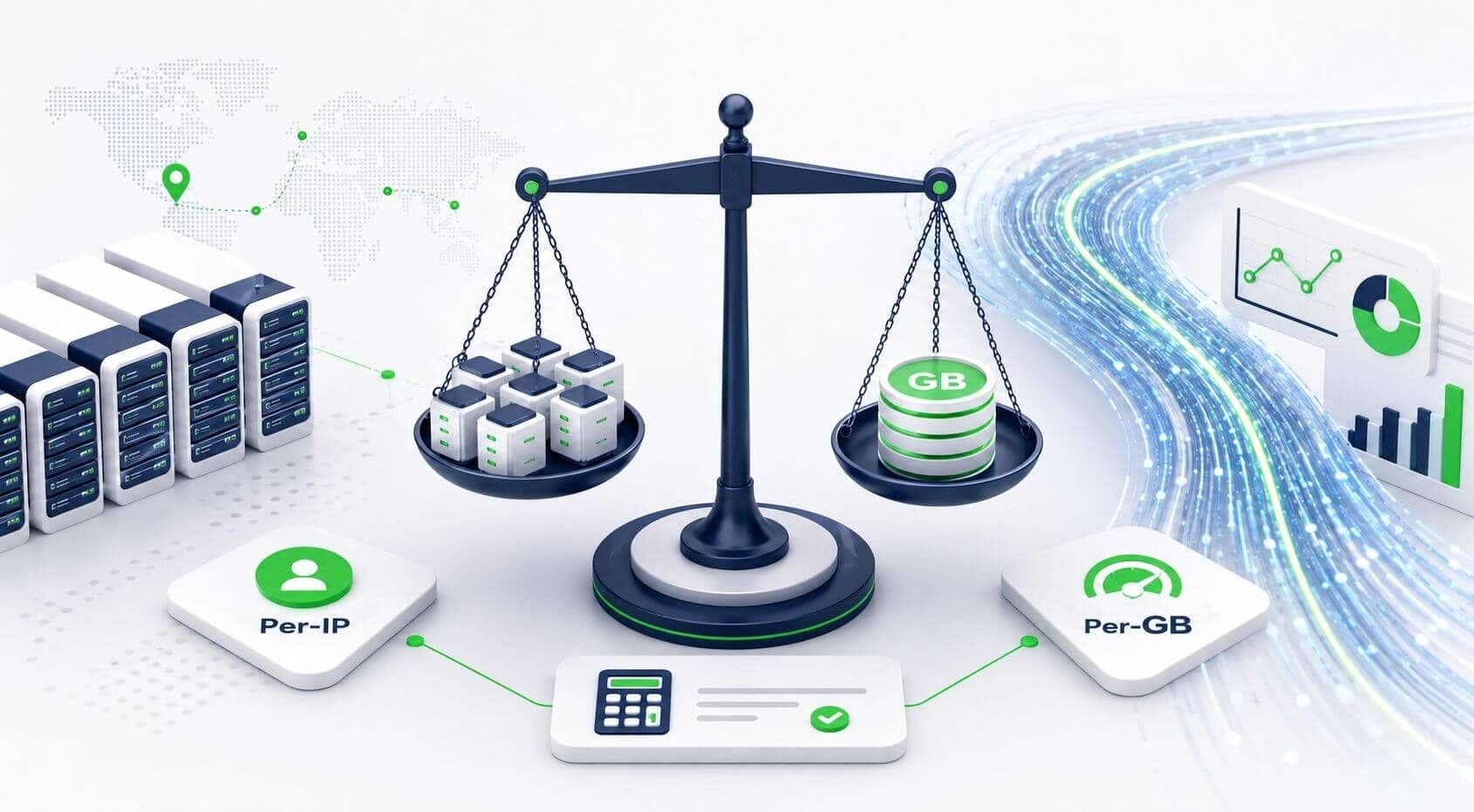
Per-IP vs per-GB proxy pricing comes down to what your workload consumes most: IP capacity or bandwidth. Per-IP pricing is usually cheaper for continuous, high-volume jobs that work well with datacenter proxies. Per-GB pricing can make more sense for low-volume projects, irregular traffic, or targets that require access to a broader rotating network.
The lowest advertised rate is not always the lowest operating cost. A useful comparison must include monthly spend, success rate, retry traffic, IP utilization, and engineering overhead.
| Factor | Per-IP pricing | Per-GB pricing |
|---|---|---|
| Billing unit | Number of proxy IPs | Data transferred |
| Budget behavior | Usually fixed | Varies with traffic |
| Best fit | Continuous, high-volume automation | Low-volume or irregular work |
| Main cost risk | Paying for unused IPs | Bandwidth spikes and retries |
| Scaling behavior | Add IPs as needed | Pay more as traffic grows |
| Common product fit | Static or bulk datacenter proxies | Rotating residential, mobile, ISP, or metered networks |
These are common patterns, not universal rules. Some providers combine both models or add bandwidth, concurrency, replacement, or fair-use restrictions. Compare the full plan terms, not only the headline unit price.
With per-IP pricing, you pay for a defined number of proxy addresses for a billing period.
Monthly proxy cost = Number of IPs × Monthly price per IP
At $0.02 per IP, a 1,000-IP pool costs:
1,000 × $0.02 = $20 per month
As of July 2026, ProxiesThatWork lists 150 proxies for $3 per month, 1,000 proxies for $20, and 2,500 proxies for $50. Its plans include HTTP/HTTPS support and IP authentication.
The main advantage is predictable spending. Once the pool is purchased, request volume does not directly change the invoice unless the plan also includes a bandwidth cap or another metered restriction.
Per-IP plans are a natural fit for recurring work such as:
Bulk datacenter pools support these workflows by spreading traffic across many IPs while keeping the monthly infrastructure cost fixed.
With per-GB pricing, you pay for data transferred through the proxy network.
Monthly proxy cost = Billable traffic in GB × Price per GB
Consider a hypothetical plan priced at $3 per GB:
50 GB × $3 = $150 per month
250 GB × $3 = $750 per month
The $3 figure is only an example. Actual rates depend on the provider, proxy type, contract size, region, and included features.
Per-GB billing can be economical when traffic is limited. A team can access a large rotating network without purchasing a fixed number of addresses. This may suit a short research project, a small number of sensitive requests, or a job that runs only a few times each month.
The risk is that every transferred byte can affect cost. HTML, API responses, browser assets, retries, and failed requests may all count toward usage, depending on the provider’s accounting method.
Per-IP pricing buys capacity. Per-GB pricing buys consumption.
With a fixed proxy pool, higher request volume can improve the value derived from each IP, provided requests remain responsible and successful. With bandwidth billing, higher volume normally creates a proportionally larger bill.
That does not make per-IP pricing automatically better. A fixed pool has poor economics when most IPs are unused or incompatible with the target. A per-GB network may justify its cost if it substantially improves access on targets that reject standard datacenter traffic.
The meaningful comparison is:
Total monthly proxy cost ÷ Successful usable results
Our guide to reducing proxy cost per successful request explains why blocks, timeouts, retries, and unusable responses belong in the calculation.
Use this formula to estimate when a fixed per-IP plan becomes cheaper:
Break-even traffic in GB = Fixed monthly per-IP cost ÷ Per-GB rate
Suppose you compare:
$20 ÷ $3 per GB = 6.67 GB
Above roughly 6.67 GB per month, the fixed plan has the lower headline cost. Below it, the metered plan costs less.
This is only a starting point. Adjust the comparison for:
A fixed pool that succeeds on 70 percent of requests may be more expensive in practice than a metered network that succeeds on 98 percent. Conversely, a compatible per-IP pool processing hundreds of gigabytes can create a large cost advantage.
A data team transfers 300 GB per month and the targets work reliably with datacenter proxies.
| Cost factor | Per-IP plan | Per-GB plan |
|---|---|---|
| Proxy fee | $20 for 1,000 IPs | $900 at a hypothetical $3/GB |
| Cost as traffic grows | Mostly fixed | Rises directly |
| Budget predictability | High | Lower |
| IP utilization | High | Not applicable |
Per-IP pricing is likely cheaper because the crawler repeatedly uses the pool. This pattern is common in continuous data collection, where recurring jobs benefit from stable monthly costs.
Another team transfers only 2 GB per month and runs two small jobs.
| Cost factor | Per-IP plan | Per-GB plan |
|---|---|---|
| Proxy fee | $20 | $6 at a hypothetical $3/GB |
| IP utilization | Low | Usage-based |
| Target compatibility | Must be tested | May be better, depending on network |
| Operational fit | Oversized pool | Small on-demand workload |
Here, per-GB pricing may be cheaper and simpler. Buying 1,000 IPs would waste most of the allocation.
Proxy type and billing model are related but separate decisions. Review the datacenter vs residential proxy cost comparison when target sensitivity may determine which network works. Datacenter proxies generally provide more predictable bulk economics, while residential services are commonly billed by traffic.
Per-IP pricing is generally the stronger choice when:
This model is particularly suitable for cheap proxies used in scraping, where high request volume and predictable cost matter more than residential network identity. Responsible pacing and performance monitoring are still essential.
Per-GB pricing often works better when:
Per-GB billing can also be practical during initial testing. The limitation appears as traffic grows. A project that expands from 20 GB to 500 GB creates a much larger proxy bill under a metered plan.
A failed request may still consume bandwidth. Repeated 403 responses, 429 responses, timeouts, and incomplete downloads can raise per-GB cost without producing usable data.
Per-IP plans still incur compute time and operational overhead when requests fail, even when the proxy invoice stays fixed.
Headless browsers may load JavaScript, images, fonts, analytics, and third-party resources. That can make a browser job far more expensive under per-GB billing than a lean HTTP client.
Block unnecessary assets only when doing so does not break functionality or reduce data accuracy.
A low unit price does not help when most of the pool sits idle. Estimate the number of IPs needed from request frequency, concurrency, target tolerance, and desired traffic distribution.
One network can perform well on a public catalog and poorly on a more restrictive platform. Test representative URLs under production-like conditions before projecting monthly cost.
Static IP lists may require internal rotation, monitoring, quarantine, and replacement logic. A managed per-GB gateway may reduce that work. Include engineering time when operational simplicity matters.
For each option, estimate:
Effective cost =
Proxy fees
+ Retry-related compute cost
+ Engineering overhead
+ Cost of missing or unusable data
Divide that amount by successful pages, records, responses, or completed datasets. This is more useful than either cost per IP or cost per GB alone.
Yes. A hybrid setup can use:
This reserves expensive traffic for the small number of requests that need it. Routing should be based on measured target performance, not automatic escalation after every failure.
No. It is usually more economical for sustained, high-volume work, but it can waste money when traffic is low or most IPs remain unused.
Run a representative sample and measure all transferred bytes, including retries and browser assets. Multiply average traffic per successful task by expected monthly volume.
Not automatically. Check for concurrency restrictions, fair-use conditions, speed limits, and acceptable-use terms.
Per-IP datacenter pricing often fits high-volume public scraping. Per-GB pricing may be better for low-volume work or targets that require another network type.
Compare cost per successful request. Attempted requests that return blocks, errors, or unusable data still consume resources.
Per-IP pricing usually wins when a team continuously uses a large datacenter proxy pool and transfers substantial traffic. Per-GB pricing usually wins when usage is light, irregular, geographically specialized, or dependent on a metered network with better target compatibility.
Do not choose based on the smallest number on a pricing page. Measure bandwidth, utilization, success rate, retries, and operational effort together.
For high-volume workflows that work with HTTP/HTTPS datacenter IPs, review the current affordable bulk proxy pricing and start with a pool size you can test against real production targets. ProxiesThatWork currently lists its plans at $0.02 per proxy per month.
Ed Smith is a technical researcher and content strategist at ProxiesThatWork, specializing in web data extraction, proxy infrastructure, and automation frameworks. With years of hands-on experience testing scraping tools, rotating proxy networks, and anti-bot bypass techniques, Ed creates clear, actionable guides that help developers build reliable, compliant, and scalable data pipelines.