

Proxies That Work logo

Why AI Needs Better Geo-Targeted Testing

By Jesse Lewis12/8/20255 min read

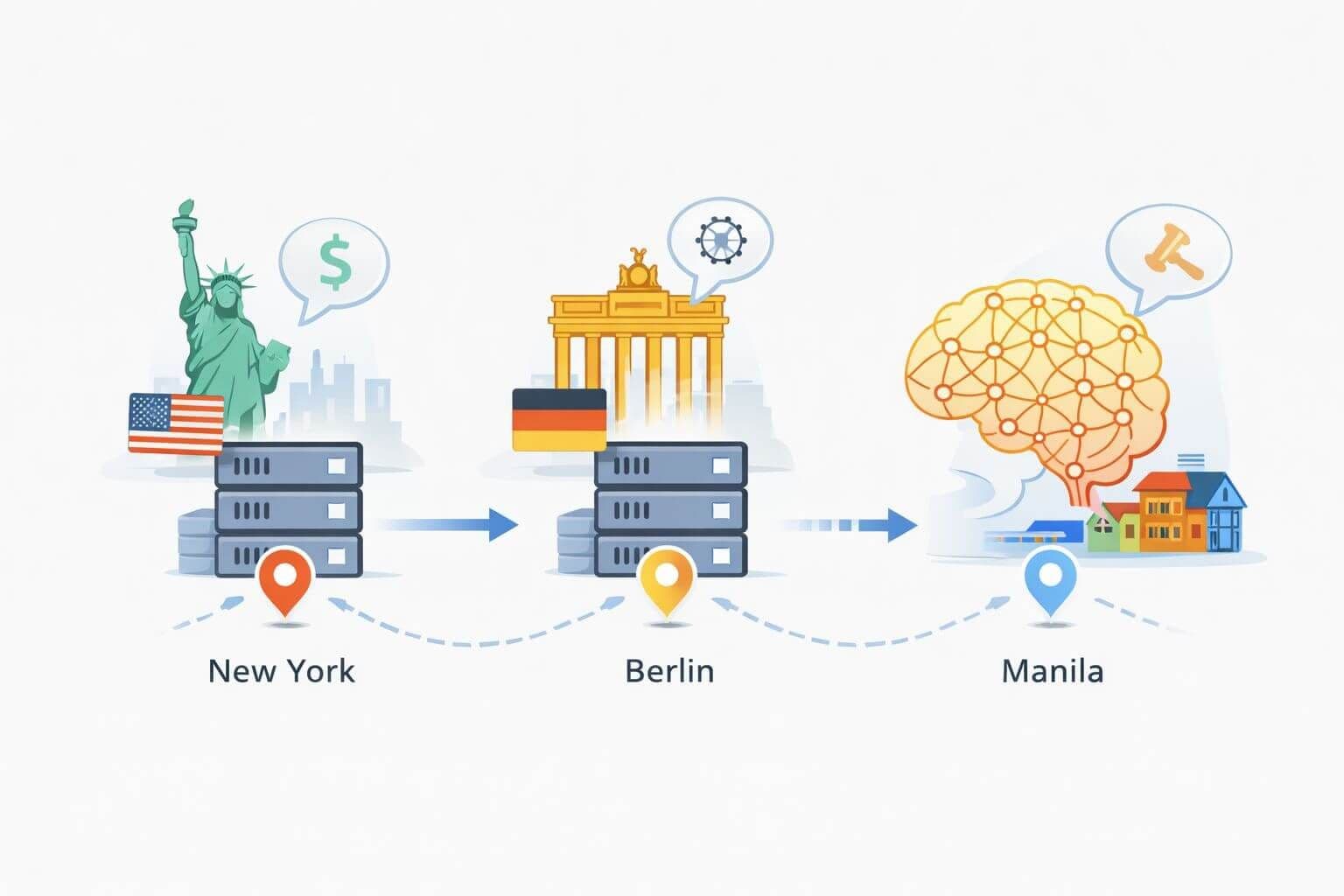
Ask the same AI the the same question from New York, Berlin, and Manila and you’ll often get three different answers. Sometimes the differences are harmless. Other times they change prices, recommendations, or even the legality of what the model suggests.

That’s where AI geo testing comes in. Instead of testing your AI experience from a single location, you deliberately probe it from multiple regions, languages, and regulatory environments to see how behavior changes.

In this guide, we’ll walk through:

  • Why models behave differently across regions
  • The real risks of ignoring geo variation
  • How to design a practical AI geo testing strategy
  • How proxies and controlled network vantage points fit into the picture

By the end, you’ll have a clear blueprint for adding AI geo testing to your evaluation stack.


What is AI geo-targeted testing?

AI geo-targeted testing means systematically evaluating your AI product from different locations and contexts:

  • Different countries and regions
  • Different languages and dialects
  • Different regulatory environments (e.g., EU vs US)

You’re not just checking translation quality. You’re checking:

  • Does the model give regionally accurate facts and prices?
  • Does it respect local legal and policy constraints?
  • Does it maintain consistent quality and tone across markets?

Think of it as localization testing, content safety checks, compliance review, and product QA all rolled into one.


Why AI responses vary by region

Modern LLMs and AI systems are layered stacks, not single models. Geo differences sneak in at multiple layers:

1. Training data and cultural bias

Models trained mostly on English-language, US-centric data will:

  • Know US brands, politics, and slang in detail
  • Struggle with local context in smaller markets
  • Over-represent one cultural viewpoint as “default truth”

Without geo testing, this bias can go unnoticed.

2. Region-specific safety and policy layers

Many AI systems apply policy filters that change with:

  • Local laws (e.g., privacy, election rules, hate-speech rules)
  • Platform policies for specific markets
  • Risk tolerance around health, finance, or legal advice

The same prompt can be allowed in one region and flagged or heavily censored in another.

3. Integration with regional data sources

AI products often sit on top of:

  • Local search indexes
  • Country-specific product catalogs and prices
  • Regional documentation or help centers

If the upstream data is different or out of sync, answers will diverge too.

4. Network and geolocation signals

Even before you add your own logic, the stack may use:

  • IP location
  • System locale and timezone
  • Billing country or account region

These signals steer everything from recommended content to compliance flows.


Risks of ignoring geo differences

If you only test your AI product from one country, you’re flying blind in every other market.

Common failure modes:

  • Wrong or missing content

    • Products “available” in a region where you don’t ship
    • Links to documentation that doesn’t exist in that language
  • Inconsistent or unfair experiences

    • Better answers in large markets, weaker answers elsewhere
    • Different safety behavior for similar users in different countries
  • Regulatory problems

    • Advice that conflicts with local tax, employment, or consumer laws
    • Handling personal data in ways that violate regional rules
  • Brand and trust damage

    • Users share screenshots showing unfair pricing or conflicting answers
    • Perception that the AI “doesn’t understand” their country or context

AI geo testing is how you catch these before they hit social media or regulators.


Where geo inconsistencies usually show up

Some areas are especially sensitive:

Factual and news-like questions

  • Country-specific laws, elections, and public figures
  • Local holidays, history, and cultural context

Pricing, availability, and offers

  • Subscription pricing that should differ by region
  • Shipping availability and delivery times
  • Tax handling (VAT, GST, local surcharges)

Regulated domains

  • Health, insurance, and medical guidance
  • Financial products and investment advice
  • Legal and employment topics

Content safety and moderation

  • Hate speech, political content, and disinformation
  • Adult or restricted topics
  • Local restrictions on certain types of speech

Where these overlap, you want extra careful AI geo testing, not less.


Designing an AI geo testing strategy

A good geo strategy is systematic but practical. You don’t need every country on day one, but you do need a clear plan.

Pick priority regions

Start with:

  • Top revenue or growth markets
  • Regions with stricter regulation (EU, UK, some US states)
  • Markets where you’ve already seen support tickets or complaints

Group similar markets to avoid combinatorial explosion (for example, “DACH”, “Nordics”, “SEA”).

Define personas and tasks

For each region, map a few core personas and workflows:

  • Consumer: “Help me choose a phone under $X in my country.”
  • Business user: “Draft a sales email for a customer in my region.”
  • Support: “Explain my bill as a customer in this country.”

Tie these to your product’s most important value propositions.

Build a geo test matrix

Your matrix might include columns like:

  • Region / country
  • Language / script
  • Use case (search, chat, agent workflow)
  • Risk level (low / medium / high)

This becomes your AI geo testing checklist for each release.


How proxies enable realistic geo testing

To test regional behavior, you need regional vantage points.

That’s where proxies and controlled network routing become essential:

  • Route traffic through country-specific exit nodes
  • Observe how the AI stack behaves with different IP regions
  • Combine with language and locale settings for more realistic sessions

High-quality datacenter proxies are usually enough for:

  • Testing AI products that rely on region-gated APIs or web data
  • Load-testing regional behaviors without moving infrastructure

You can then layer:

  • Different headers and locales (Accept-Language, timezones)
  • Region-specific accounts or profiles where relevant

Proxies don’t replace your AI evaluation; they make geo behavior observable.


Implementing an AI geo testing workflow

Here’s a practical, repeatable flow many teams adopt:

  1. Define your prompts and scenarios

    • Turn real user journeys into prompt templates
    • Parameterize region, language, and product details
  2. Route through regional endpoints

    • For each region in your matrix, use a country-targeted proxy
    • Ensure your app or testing harness tags requests with region metadata
  3. Capture full responses and traces

    • Store prompt, response, region, model version, and timestamp
    • Include safety flags, latency, and upstream API signals
  4. Score and compare

    • Automatic checks: checklists, keyword coverage, policy violations
    • Human review: annotators compare regions side-by-side for quality and fairness
  5. Alert and iterate

    • Flag large divergences, missing content, or inconsistent safety behavior
    • Feed issues back into model tuning, policy rules, or product logic

Over time, this becomes part of your standard release pipeline, not a one-off task.


Example scenarios for AI geo testing

A few concrete examples show how this plays out in practice.

Scenario 1: Global e-commerce assistant

You operate in 15+ countries with different:

  • Currencies and taxes
  • Shipping options
  • Product assortments

AI geo testing helps confirm that:

  • Each region gets the right prices and availability
  • Promotions don’t leak across borders
  • Local regulations on returns and warranties are explained correctly

Scenario 2: Knowledge assistant for a SaaS product

Your docs are translated into several languages at different times.

Geo testing checks:

  • Whether the assistant links to the right localized docs
  • If it falls back gracefully when translations are missing
  • How it handles region-limited features and legal disclaimers

Scenario 3: Risk and compliance assistant

You offer internal AI tools for legal, compliance, or HR teams.

Geo testing verifies:

  • That content references the correct jurisdiction
  • That disclaimers match local rules
  • That certain topics are treated more cautiously in high-risk regions

In all of these, proxies and regionally aware test harnesses are how you move from theory to measurable behavior.


Metrics to track in AI geo testing

To move from anecdotes to signal, track:

  • Accuracy and relevance

    • Does the answer match ground truth or policy for that region?
  • Consistency across markets

    • Do similar users in similar contexts get comparable experiences?
  • Safety and compliance signals

    • Are risky topics answered differently where required?
  • Coverage and fallback quality

    • When localized data is missing, is the fallback honest and helpful?
  • Latency and reliability by region

    • Are certain markets consistently slower or more error-prone?

These metrics give your product, policy, and infra teams something concrete to improve.


Governance, logging, and ethics

AI geo testing touches real users’ contexts and sometimes sensitive topics. Treat it as a governed process:

  • Minimize personal data in prompts and logs
  • Use synthetic or anonymized scenarios when possible
  • Apply internal review for high-risk use cases
  • Document where and why geo-specific rules are applied

The goal is not only to avoid trouble; it’s to build fair, predictable experiences for users everywhere.


How ProxiesThatWork fits into AI geo testing

Teams doing AI geo testing at scale need:

  • Stable, predictable datacenter exit nodes across key regions
  • Simple authentication and configuration for test harnesses
  • Clear pricing that scales with experimentation

That’s exactly what developer-friendly proxy networks are designed for.

You can:

  • Use country-specific proxy pools to simulate users in multiple markets
  • Attach those proxies to your Python, Node.js, or Go test runners
  • Reuse the same network layer across QA, monitoring, and data pipelines

As your AI geo testing matures, you’ll often blend:

  • Centralized proxy management
  • Language-specific test harnesses
  • Shared dashboards that aggregate results by region and use case

Frequently Asked Questions

What is AI geo testing?

AI geo testing is the practice of evaluating an AI system’s behavior from multiple regions and languages. Instead of testing only from one country, you route traffic through regional endpoints and compare answers, safety behavior, and quality across markets.

Why do LLMs answer differently in different countries?

Models inherit biases from training data, plus layers of region-specific policy, safety filters, and integrations. On top of that, your product may change behavior based on IP, account region, or local data sources. All of this leads to geo-dependent answers.

Do I always need residential IPs for AI geo testing?

Not always. For many AI products and open-web data sources, well-configured datacenter proxies are enough to see meaningful regional differences. Residential IPs may be useful when you need to mimic consumer traffic more closely, but they are not required for every scenario.

How often should I run AI geo tests?

Most teams start with pre-release test suites for major launches and then add scheduled regression runs (e.g., daily or weekly) for critical workflows. As your risk surface grows, continuous monitoring across a small set of key prompts per region becomes increasingly important.

What’s the difference between AI geo testing and localization testing?

Localization testing focuses on language, UI, and UX details like translations and formatting. AI geo testing focuses on model behavior and policy: what the AI says, what it recommends, and how it handles region-specific rules. In a good QA process, they complement each other.


AI is increasingly the front door to your product. If it behaves well in one region and unpredictably in others, users will notice. Thoughtful AI geo testing turns that risk into an advantage: you discover issues before your customers do, and you ship an experience that feels genuinely global, not just translated.

Why AI Needs Better Geo-Targeted Testing

About the Author

J

Jesse Lewis

Jesse Lewis is a researcher and content contributor for ProxiesThatWork, covering compliance trends, data governance, and the evolving relationship between AI and proxy technologies. He focuses on helping businesses stay compliant while deploying efficient, scalable data-collection pipelines.

Proxies That Work logo
© 2025 ProxiesThatWork LLC. All Rights Reserved.