

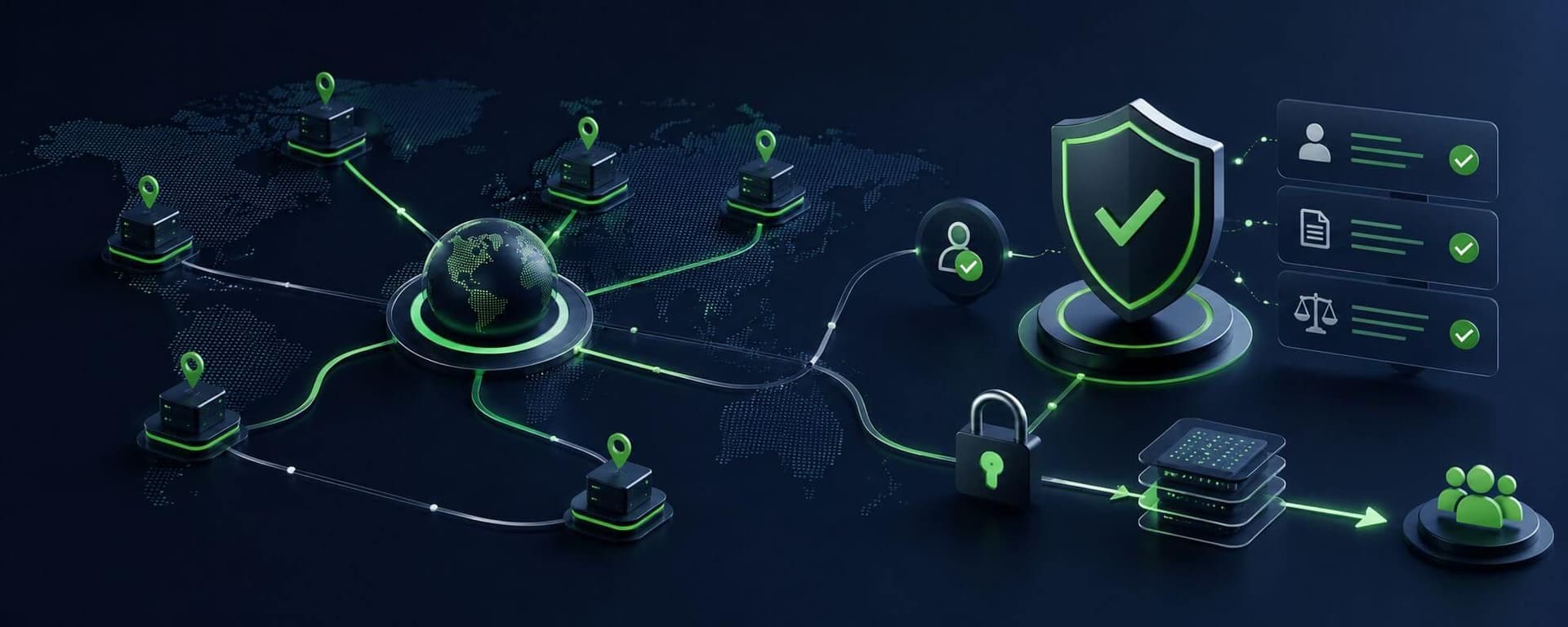
Proxy ethics begins before the first request is sent.
A proxy network can be technically reliable, fast, and geographically diverse while still creating serious risk if its IP addresses were sourced without meaningful participation, if customers use the network outside authorized purposes, or if collected data is retained and reused without appropriate governance.
For organizations using proxies for market research, fraud prevention, ad verification, testing, public-data collection, or competitive intelligence, responsible use has three distinct layers:
Ethical proxy use = responsible IP sourcing + responsible access + responsible data governance
Each layer requires different controls.
This guide explains how to evaluate consent in residential and device-based proxy networks, what responsible IP sourcing looks like, how privacy laws can apply to collected data, and what procurement and engineering teams should ask before trusting a proxy provider.
Important: Proxy technology itself does not determine whether an activity is lawful or ethical. The answer depends on how the IPs were sourced, what is accessed, how it is accessed, what data is processed, the jurisdictions involved, and the applicable contractual and legal obligations.
Proxy consent is the informed agreement of a person or organization to allow an IP address, internet connection, device, or network resource under their control to participate in a proxy network.
The issue is most relevant to proxy products that depend on third-party consumer or device connectivity.
That includes some:
Consent is generally much less complicated for conventional datacenter infrastructure because the proxy operator normally leases or controls the servers and IP resources directly.
This difference is one reason teams should understand the underlying network type rather than treating all proxies as interchangeable. The broader datacenter vs residential proxy comparison explains how those network models differ operationally.
One of the most important distinctions in proxy ethics is:
IP classification is not the same as sourcing model.
An address may be classified as residential or ISP-associated, but that alone does not tell you:
Likewise, calling a product a "residential proxy" does not prove that every exit node represents an actively participating household device.
Responsible procurement therefore starts with provenance, not marketing terminology.
Poor sourcing practices can create risks for several parties.
If a consumer connection participates in a proxy network without meaningful disclosure, the participant may not understand:
The ethical issue is not simply whether the user clicked "accept."
The more useful question is:
Could a reasonable participant understand what they were agreeing to?
Customers also inherit sourcing risk.
A company may build a legitimate analytics program around a proxy network and later discover that the provider cannot adequately explain where its residential addresses came from.
That can create:
A provider that cannot demonstrate provenance, abuse controls, and participant governance has a weaker foundation for long-term operation.
Ethical sourcing is therefore not separate from network quality. It is part of infrastructure resilience.
Consent should be more than an obscure provision inside a long privacy policy.
For device- or application-based participation, a strong consent model should make several points understandable before enrollment.
Participants should be told that their internet connection or device may be used to route network traffic for other customers.
The explanation should cover:
Where consent is the legal or ethical basis for participation, opting in should involve an affirmative action rather than relying on silence or an unrelated installation choice.
This becomes particularly important in European contexts when software stores information on or accesses information from a user's terminal equipment. Article 5(3) of the EU ePrivacy Directive generally requires clear information and consent for such access, subject to defined exceptions.
That does not mean every proxy relationship automatically falls under Article 5(3). The specific software behavior, device interaction, jurisdiction, and applicable national implementation matter.
A participant should be able to stop participating without unreasonable friction.
Operationally, revocation should also propagate to the routing layer so that removed devices or connections stop serving proxy traffic.
If users are paid or receive another benefit for sharing connectivity, the exchange should be clear.
Participants should be able to understand:
Providers operating large peer-based networks should be able to demonstrate that participation is governed rather than merely asserted.
Useful records can include:
The purpose is accountability, not unnecessary collection of participant data.
Datacenter proxies usually present the simplest sourcing model.
The provider typically:
There normally is no consumer endpoint whose bandwidth must be volunteered.
The principal sourcing questions are therefore different:
Datacenter sourcing can still be poorly managed, but the consumer-consent issue is generally much smaller than with peer-based residential networks.
Residential networks require more scrutiny because their defining value comes from IP addresses associated with consumer ISP networks.
Possible sourcing models include:
The sourcing model should be documented clearly enough for a customer to understand where network capacity originates.
Ask:
If the provider cannot explain its sourcing architecture at a meaningful level, treat that as a procurement risk.
Mobile proxy networks can involve cellular connections, SIM-based infrastructure, devices, modem banks, or other arrangements.
The same principle applies:
Do not infer ethical sourcing merely because the IP is mobile-classified.
Verify:
Mobile network identity is a technical characteristic. It is not proof of consent.
A mature proxy provider should be able to demonstrate five things.
| Area | What Good Practice Looks Like |
|---|---|
| Provenance | Provider can explain where IP capacity originates |
| Participation | Third-party participants receive meaningful disclosure |
| Control | Participants can stop or revoke participation |
| Abuse prevention | Restricted uses, monitoring, and complaint mechanisms exist |
| Accountability | Provider maintains records and can investigate incidents |
This is a stronger standard than simply asking whether a provider describes its network as "ethical."
This distinction is critical.
Suppose a residential participant legitimately agrees to provide network bandwidth.
That consent governs participation in the proxy network.
It does not automatically authorize the proxy customer's collection or processing of whatever information can be reached through that connection.
There are two separate relationships:
Proxy participant → proxy provider
and:
Proxy customer → target website/data subjects
A legitimate sourcing model does not remove the customer's responsibility to evaluate its own data-collection activities.
Another common misconception is:
If information is publicly visible, privacy law no longer matters.
That is too broad.
Under the GDPR, personal-data processing remains subject to principles such as lawfulness, fairness, transparency, purpose limitation, data minimization, storage limitation, and security.
Organizations also need an applicable lawful basis under Article 6. Legitimate interests can be one possible basis, but it is not an automatic exemption. The organization's interests must be weighed against the rights and freedoms of the individuals concerned.
Therefore:
Public availability affects the analysis, but it does not automatically eliminate data-protection obligations.
A responsible proxy program should define why data is collected before deciding how much data to collect.
Document the intended use.
Examples might include:
Avoid gradually expanding a dataset into unrelated uses without reassessing the legal and ethical basis.
Collect only the fields needed for the business purpose.
If a price-monitoring system requires:
Product ID
Price
Currency
Availability
Timestamp
there may be no reason to store:
Customer name
Profile photograph
Personal email
Unrelated comments
Minimization reduces:
Define how long information remains useful.
Not every raw response needs permanent storage.
Use:
Storage limitation is also a core GDPR principle. Identifiable personal data generally should not be retained longer than necessary for its processing purpose, subject to applicable exceptions.
In European privacy frameworks, responsibilities can differ depending on whether an organization acts as a controller or processor.
A controller determines the purposes and essential means of processing.
A processor processes personal data on behalf of a controller according to its instructions.
The distinction depends on the actual processing activity, not simply what the contract calls the company.
For proxy-backed collection projects, determine:
Those answers help identify where governance responsibility sits.
Ethical collection loses its value if the resulting data is poorly protected.
Useful controls include:
Proxy systems frequently produce very detailed logs.
Be cautious about retaining:
For operational monitoring, metadata such as the following is often sufficient:
timestamp
target
proxy pool
region
status code
latency
retry reason
Log what you need to operate the system, not everything the system can capture.
Large proxy-backed collection programs can sometimes create higher privacy risks, particularly when they involve:
Under GDPR Article 35, a Data Protection Impact Assessment is required where processing is likely to result in a high risk to individuals' rights and freedoms.
A DPIA is not required merely because a proxy is involved.
It is the nature, scope, context, purpose, and risk of the data processing that matter.
California's CCPA/CPRA framework also distinguishes between different categories and uses of personal information.
Covered businesses may need to provide rights including access, deletion, correction, and, where applicable, the ability to opt out of the sale or sharing of personal information.
The important operational lesson is:
Do not assume that "found on the public web" is a complete privacy analysis.
Determine:
The U.S. Computer Fraud and Abuse Act is frequently mentioned in web-scraping discussions, but it should not be summarized as "scraping violates the CFAA."
The U.S. Supreme Court's decision in Van Buren v. United States interpreted "exceeds authorized access" relatively narrowly, focusing on obtaining information from areas of a computer system that were actually off limits.
Separately, in hiQ Labs v. LinkedIn, the Ninth Circuit held at the preliminary-injunction stage that hiQ raised serious questions about whether the CFAA's "without authorization" concept applied to information that LinkedIn made freely accessible to the public.
Those cases do not establish that all public-web scraping is lawful.
Other issues may still include:
For a broader treatment of the subject, PTW's guide to whether proxies are legal provides additional context.
Responsible crawlers should account for publisher-provided crawler instructions.
The Robots Exclusion Protocol is formally specified in RFC 9309 and provides a standardized way for website operators to communicate crawling preferences.
Importantly, the RFC states that robots.txt rules are not a form of access authorization.
That distinction matters.
robots.txt should not be described as either:
For ethical crawler design, it is an important machine-readable signal that should be incorporated into access policies where applicable.
Rotation should not be used to erase evidence that a target is asking for less traffic.
A responsible proxy rotation and pool-management strategy should distinguish between traffic distribution and attempts to circumvent explicit access controls.
Good operational behavior includes:
For example, HTTP 429 Too Many Requests should generally trigger rate-control logic.
Automatically cycling through hundreds of addresses while maintaining the same excessive request rate can simply distribute poor behavior across a larger network.
If your privacy framework requires honoring access, correction, deletion, or objection requests, you need to know how to find relevant records.
This becomes difficult when organizations collect massive quantities of loosely structured public data without:
Design the data pipeline so that records can be traced to:
Governance cannot be added effectively after billions of records have accumulated.
A proxy provider should be evaluated as part of your supply chain, not merely as a network utility.
Ask the provider to explain how each major pool type is sourced.
The answer should distinguish:
Where third-party devices or connections participate, ask to review the actual enrollment experience.
Do not rely solely on statements such as:
"All users have agreed to our terms."
Ask what users actually see.
Determine:
Ask what categories of traffic are prohibited and how violations are detected.
A mature provider should have:
PTW's bulk proxy compliance practices explains how these controls can be incorporated into enterprise proxy operations.
Ask:
Look for evidence beyond marketing language.
Depending on the service, useful evidence may include:
Treat these as reasons for additional investigation rather than automatic proof of wrongdoing:
Transparency does not guarantee ethical operation, but absence of transparency makes responsible procurement considerably harder.
A practical governance model looks like:
IP Sourcing
    ↓
Vendor Due Diligence
    ↓
Authorized Workload
    ↓
Access Controls
    ↓
Data Minimization
    ↓
Secure Processing
    ↓
Retention / Deletion
    ↓
Audit and Review
Each layer answers a different question.
Verify provenance and consent where third-party connectivity is involved.
Document what will be accessed and why.
Set request limits and collect only what is necessary.
Apply privacy principles, lawful-basis analysis, and appropriate safeguards.
Maintain enough records to explain what happened without collecting excessive logs.
Revocation and deletion must work in practice.
Before approving a proxy-backed project, verify:
Consent means that a person or organization whose device, connection, or network resource participates in a proxy system understands that participation and has agreed to it through an appropriate mechanism. The exact legal requirements vary according to the technology and jurisdiction.
Not inherently. Datacenter proxies generally have a simpler provenance model because infrastructure is usually controlled directly by the provider. Residential networks can also be responsibly operated when sourcing, consent, participant controls, and abuse prevention are handled properly.
No. Public availability does not automatically remove all privacy obligations. Whether a law applies depends on the type of information, jurisdiction, purpose, organization, exemptions, and subsequent processing.
No. RFC 9309 specifically states that the Robots Exclusion Protocol is not an authorization mechanism. It is an important crawler-control standard, but legal authorization is a separate question.
There is no universal rule that all web scraping violates the CFAA. U.S. case law distinguishes between different forms of access, and other legal claims can apply independently. Organizations should assess the particular target, access controls, jurisdiction, and use case rather than relying on a blanket statement.
Usually not by itself. A proxy changes the network path. Privacy obligations arise primarily from the collection and processing of personal data, although the proxy provider itself may also have separate responsibilities relating to participants, customers, and network data.
A major warning sign is an inability or unwillingness to explain how residential endpoints enter the network and how participants can stop participating.
Responsible proxy use is not determined by whether an IP is datacenter, ISP, residential, or mobile.
It depends on the full lifecycle.
Before traffic is routed: understand where proxy capacity came from and whether third-party participation is legitimate.
While traffic is routed: use the network for defined, authorized purposes with proportionate request behavior.
After data is collected: minimize, secure, retain, and delete information according to applicable obligations and documented business needs.
The strongest proxy programs treat consent, sourcing, security, access policy, and data governance as parts of the same infrastructure decision.
That approach produces something more valuable than a large proxy pool:
a network and data-collection system that can withstand technical, procurement, privacy, and reputational scrutiny.
Nicholas Drake is a seasoned technology writer and data privacy advocate at ProxiesThatWork.com. With a background in cybersecurity and years of hands-on experience in proxy infrastructure, web scraping, and anonymous browsing, Nicholas specializes in breaking down complex technical topics into clear, actionable insights. Whether he's demystifying proxy errors or testing the latest scraping tools, his mission is to help developers, researchers, and digital professionals navigate the web securely and efficiently.