

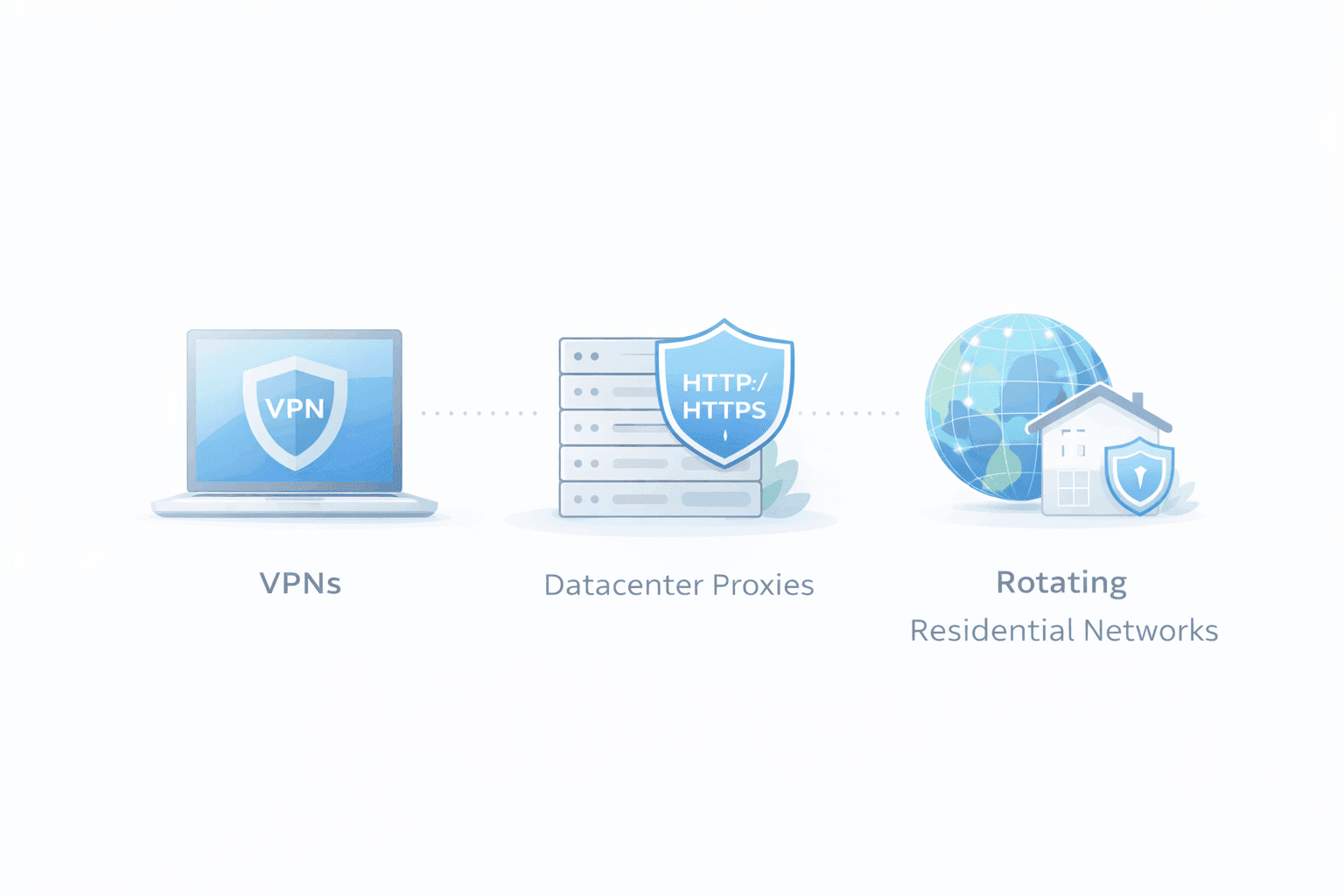
Online privacy and network-access tools have expanded well beyond traditional VPNs. Developers, QA teams, security professionals, and data operations teams can now choose from VPNs, datacenter proxies, ISP proxies, residential proxy networks, managed gateways, and browser-based access infrastructure.
These technologies overlap, but they are not interchangeable.
A VPN is primarily designed to route and encrypt a user's network traffic through another endpoint. A proxy is generally more granular, allowing individual applications or requests to use specific IP addresses, locations, or sessions. Rotating residential networks add another layer by dynamically routing traffic through large pools of ISP-assigned residential IPs.
The shift is not simply from one technology to another. Modern infrastructure increasingly uses different network types for different workloads, balancing privacy, performance, geographic requirements, operational control, and cost.
Older architectures often relied on one VPN exit or a small group of static proxy IPs.
That model remains useful for many purposes, but it becomes limiting when applications need:
Modern websites and network services also use more sophisticated traffic-management and security systems.
They may evaluate signals such as:
As a result, simply changing an IP address does not automatically solve reliability problems.
Teams increasingly need to match the network architecture to the workload rather than expecting a single VPN or proxy type to handle everything.
A broader understanding of IP reputation management is especially important when the same proxy infrastructure supports recurring automated traffic.
The most important differences involve routing scope, IP characteristics, automation, scale, and cost.
| Feature | VPN | Datacenter Proxy | Rotating Residential Network |
|---|---|---|---|
| Primary purpose | User/device traffic routing and privacy | Application-level routing and automation | Large-scale routing through residential IPs |
| IP source | VPN provider servers | Hosting/data center networks | Consumer ISP networks |
| Automation | Limited to moderate | Excellent | Excellent |
| IP diversity | Usually limited | High with large pools | Potentially very high |
| Speed | Generally good | Usually very high | More variable |
| Cost | Usually subscription-based | Often relatively low | Usually higher |
| Session control | Provider-dependent | Application-controlled | Often supports sticky sessions |
| Typical fit | Personal privacy, secure access | Crawling, monitoring, QA, APIs | Geo-sensitive or residential-network workloads |
Each technology solves a different problem.
VPNs remain highly useful for:
Their main limitation for large automated systems is scale.
A VPN service may provide several locations or exit nodes, but application developers typically have less control over request-level IP assignment than they would with proxy infrastructure.
For human-driven browsing and secure remote access, that simplicity is often an advantage.
For large crawling or testing systems, it can become a limitation.
Datacenter proxies route traffic through IP addresses hosted in data centers or server networks.
They are particularly useful because they generally provide:
Datacenter proxies are often appropriate for:
They are especially attractive when the target does not require residential network characteristics.
For these workloads, the economics of datacenter versus residential proxy infrastructure often favor datacenter IPs because residential networks commonly use more expensive bandwidth-based pricing.
A rotating residential proxy network routes requests through IP addresses assigned by consumer internet service providers.
Instead of connecting directly to individual residential IPs, customers commonly connect to a gateway that selects an available exit address from a larger network.
A simplified architecture looks like:
Application
    ↓
Residential Proxy Gateway
    ↓
Residential IP Pool
    ↓
Target Service
The gateway may provide controls for:
The exact features vary considerably between providers.
Residential proxy networks typically use one or more allocation models.
The gateway may assign another residential IP for each independent request.
This can be appropriate for stateless workloads where session continuity is unnecessary.
A sticky session keeps the same proxy exit for a specified period.
For example:
Session A → Residential IP 1
Session B → Residential IP 2
Session C → Residential IP 3
Requests associated with Session A continue through the same available IP until the session expires or the network needs to reassign it.
Sticky sessions are useful when applications need:
Some gateways rotate addresses automatically after a configured interval.
This can work well for longer-running monitoring jobs where permanent IP persistence is unnecessary.
The broader choice between controlling rotation internally and delegating it to a gateway is covered in the comparison of scripted versus managed proxy rotation.
Residential networks can provide network characteristics that datacenter proxies cannot.
Residential IP addresses originate from consumer ISPs rather than hosting providers.
This can matter for applications that legitimately need to observe how services behave from residential networks.
Large residential networks may provide access to many countries, regions, and cities.
This can support:
Residential networks can offer a broader pool of potential exit addresses than organizations could reasonably maintain themselves.
This is useful for geographically distributed workloads.
Residential proxies are not automatically better than datacenter proxies.
They introduce several important trade-offs.
Residential bandwidth is generally more expensive.
A crawler that downloads unnecessary images, JavaScript bundles, video, or other large assets can quickly consume significant bandwidth.
Because traffic traverses consumer-network infrastructure, latency and throughput can vary more than on dedicated datacenter networks.
Organizations should understand how a residential network obtains access to its IP addresses.
This includes reviewing:
Residential endpoints are not necessarily permanently online.
Applications should be designed to tolerate IP reassignment and temporary exit-node availability changes.
Residential proxy sourcing deserves particular scrutiny because the network relies on third-party internet connections.
Organizations evaluating a provider should ask:
Technical performance should not be evaluated separately from sourcing practices.
Teams operating proxy infrastructure should also establish compliance controls for bulk proxy usage, including rules around authorized access, privacy, data retention, and acceptable workloads.
Choosing between datacenter and residential networks is ultimately an infrastructure decision.
Datacenter proxies generally offer lower and more predictable latency.
Residential networks can have greater variance because traffic exits through consumer ISP connections.
Datacenter infrastructure is typically better suited to high-throughput collection.
Residential networks may still support significant concurrency, but throughput should be tested with the actual workload.
Residential services are frequently priced by traffic volume.
Teams should minimize unnecessary downloads by:
The relevant measurement is not simply whether one proxy type has a higher nominal success rate.
Teams should evaluate:
Total infrastructure cost ÷ successful, usable requests
The cheapest network on a per-GB or per-IP basis may not be the cheapest after retries and failed collection are included.
The growth of residential networks does not mean datacenter proxies are becoming obsolete.
For many production workloads, they remain the preferred first option.
Typical examples include:
Datacenter proxies are especially attractive when teams require large-scale, predictable capacity.
Automated systems can also rotate datacenter proxies programmatically using round-robin allocation, health-aware routing, sticky sessions, cooldowns, or dedicated proxy managers.
Many production environments do not need to choose one proxy type exclusively.
A better architecture can assign infrastructure according to workload requirements.
Use datacenter proxies for targets where they provide acceptable reliability.
These workloads generally benefit from:
Use ISP, residential, or other specialized networks only when the workload genuinely requires those network characteristics.
This prevents expensive network capacity from being used for tasks that could run reliably on less costly infrastructure.
Some systems maintain an alternate route when the primary infrastructure becomes unavailable.
Fallback should be based on defined operational criteria rather than automatically switching networks after every HTTP error.
For example:
Primary Pool
    ↓
Health / Policy Check
    ↓
Retry or Reschedule
    ↓
Approved Alternate Pool
This makes routing decisions measurable and easier to audit.
A mature network-access layer can separate applications from individual proxy providers.
For example:
Applications / Crawlers
          ↓
     Routing Layer
          ↓
 ┌────────┼─────────┐
 ↓        ↓         ↓
DC Pool  ISP Pool  Residential Pool
          ↓
     Target Services
          ↓
       Metrics
          ↓
     Routing Policy
The routing layer can consider:
This design makes network selection an infrastructure decision rather than something hardcoded into every crawler.
Multi-network systems require consistent telemetry.
Useful metrics include:
Monitor these metrics separately for each network type.
Without segmentation, a strong-performing datacenter pool may hide problems in a residential network, or vice versa.
Before choosing a proxy or VPN architecture, ask:
They serve different purposes. VPNs are primarily designed to route and protect user or device traffic, while rotating residential networks provide application-level access to larger pools of residential IP addresses.
Not necessarily. Privacy depends on factors such as provider logging, encryption, architecture, data handling, and trust. Residential network identity does not automatically provide stronger privacy.
Residential networks generally have higher sourcing and bandwidth costs than data-center infrastructure. Many providers therefore charge according to traffic volume.
Yes. Datacenter proxies remain highly effective for high-volume workloads where hosting-network IPs are accepted. They are typically faster and less expensive than residential proxies.
A backconnect gateway provides one proxy endpoint that routes traffic through a larger underlying pool. The gateway manages exit-IP selection according to rotation or session rules.
No. First determine why the workload is failing. Rate limits, application errors, session problems, authentication issues, or excessive concurrency may not be solved simply by changing network type.
Review sourcing practices, consent mechanisms, acceptable-use policies, privacy documentation, logging practices, geographic coverage, performance, and pricing.
The future is unlikely to be a simple progression from VPNs to residential proxies.
Instead, network infrastructure is becoming more specialized.
VPNs will continue serving secure user connectivity. Datacenter proxies will remain important for fast, economical automation. ISP and residential networks will serve workloads that genuinely require those network characteristics.
The more important trend is the development of policy-aware routing layers that choose the appropriate network for each workload.
Rather than asking which technology should replace the others, production teams should ask:
Which network provides the required reliability, performance, geographic coverage, compliance profile, and cost for this specific workload?
For many applications, the answer will still begin with cost-efficient datacenter proxy infrastructure, with specialized networks added only where their additional capabilities justify the expense.
Jesse Lewis is a researcher and content contributor for ProxiesThatWork, covering compliance trends, data governance, and the evolving relationship between AI and proxy technologies. He focuses on helping businesses stay compliant while deploying efficient, scalable data-collection pipelines.