

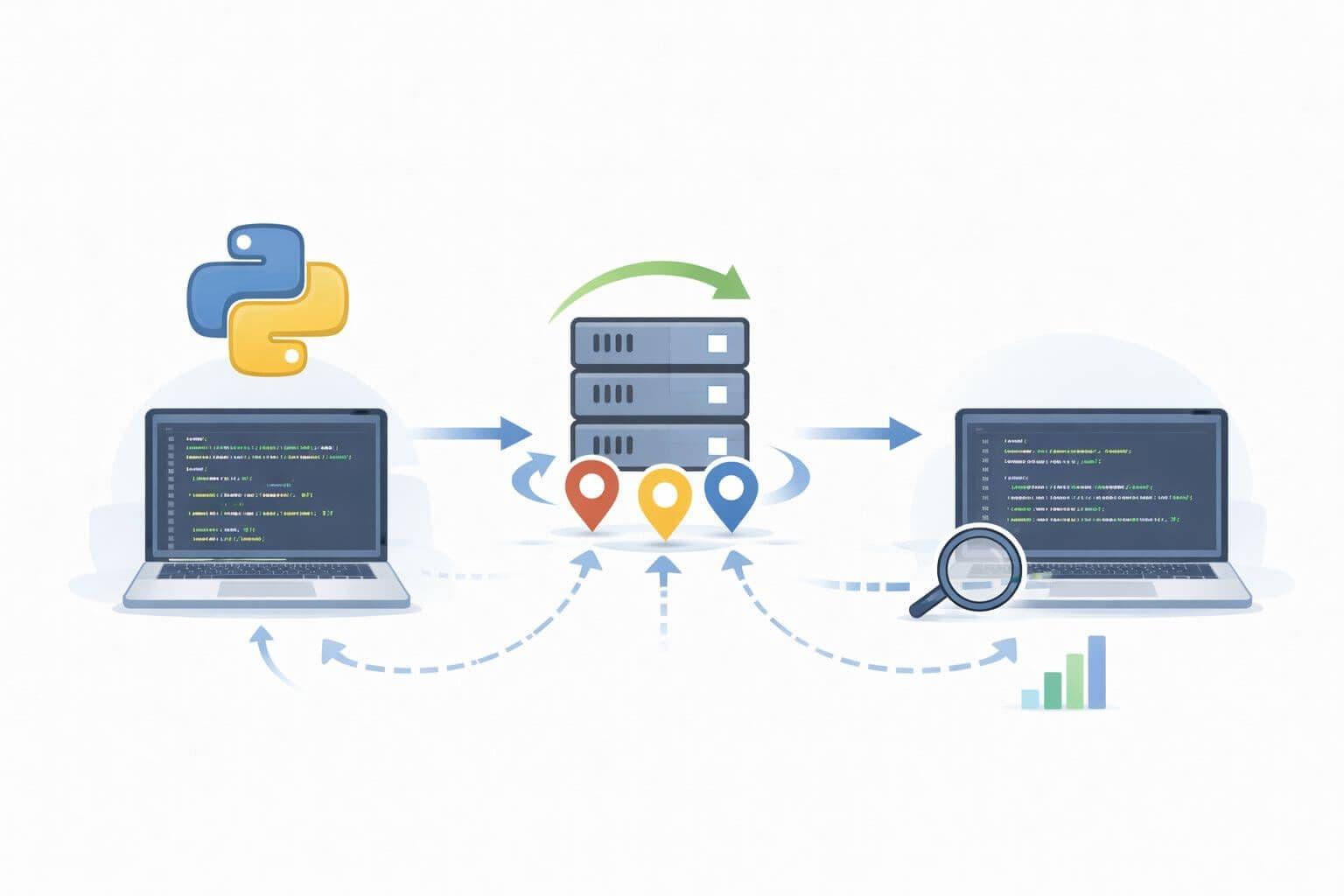
Python has become the default language for automation: web scraping, monitoring, ETL jobs, SEO tools, and AI data ingestion pipelines. As soon as those workloads grow beyond a few hundred requests a day, proxies stop being an optional “nice to have” and become core infrastructure.
This guide walks through practical Python proxy patterns for large-scale automation:
All examples assume you’re using datacenter or dedicated proxies from a reputable provider and that your use cases are legal and compliant.
Python’s ecosystem makes it easy to bolt proxies into your stack:
Proxies in this context help you:
At small scale, a single proxy endpoint is fine. At large scale, you need patterns, not one-off snippets. (See also: Proxy Rotation in Python)
Before jumping to code, clarify three core ideas.
A proxy pool is a managed collection of proxy endpoints:
protocol://user:pass@host:port stringsYou almost never want “one big global pool” for everything. Segmenting pools lets you tune behavior per target or per customer.
Proxy rotation defines how and when you switch between IPs:
Good rotation patterns avoid hammering the same IP and also avoid over-rotating unnecessarily (which can look suspicious on login flows). For more on rotation trade-offs, read Comparing Proxy Rotation Methods: Scripted vs Managed.
Different targets have different tolerance:
You’ll want per-target settings for:
Think of each target as having its own profile.
# Round-robin proxy rotation using requests
# Health scoring and retries for robust proxy usage
# Async example with httpx and aiohttp for concurrent requests
# Dynamic behavior tuned per target profile and proxy pool
# Temporarily pause traffic when targets are misbehaving
# Use session identifiers to enable IP stickiness via proxy gateways
At scale, “it’s failing sometimes” is not enough. You need observability.
Log at least:
Then, build simple dashboards:
(Also relevant: How to Avoid IP Blacklisting)
No proxy pattern is worth it if it violates laws or terms of service. Ethics, transparency, and consent matter. For guidance, see Understanding Proxy Consent & Data Ethics.
Depends on the workload: requests for sync jobs, httpx or aiohttp for async pipelines.
Depends on concurrency, strictness of target, and error rate tolerance. Start small and scale.
Only for stateless endpoints. Use sticky sessions for workflows that need continuity.
Track per-IP error rates, latency, and block signals. Drop outliers.
Use both. Rotating proxies scale, static proxies give consistency. See Fixed IPs vs Rotating Proxies.
Large-scale automation in Python depends on pattern maturity more than fancy libraries:
For a robust proxy foundation, use clean, transparent datacenter proxies designed for automation. Visit bulk datacenter proxy pricing to find scalable, affordable options aligned with these Python patterns.
Ed Smith is a technical researcher and content strategist at ProxiesThatWork, specializing in web data extraction, proxy infrastructure, and automation frameworks. With years of hands-on experience testing scraping tools, rotating proxy networks, and anti-bot bypass techniques, Ed creates clear, actionable guides that help developers build reliable, compliant, and scalable data pipelines.