

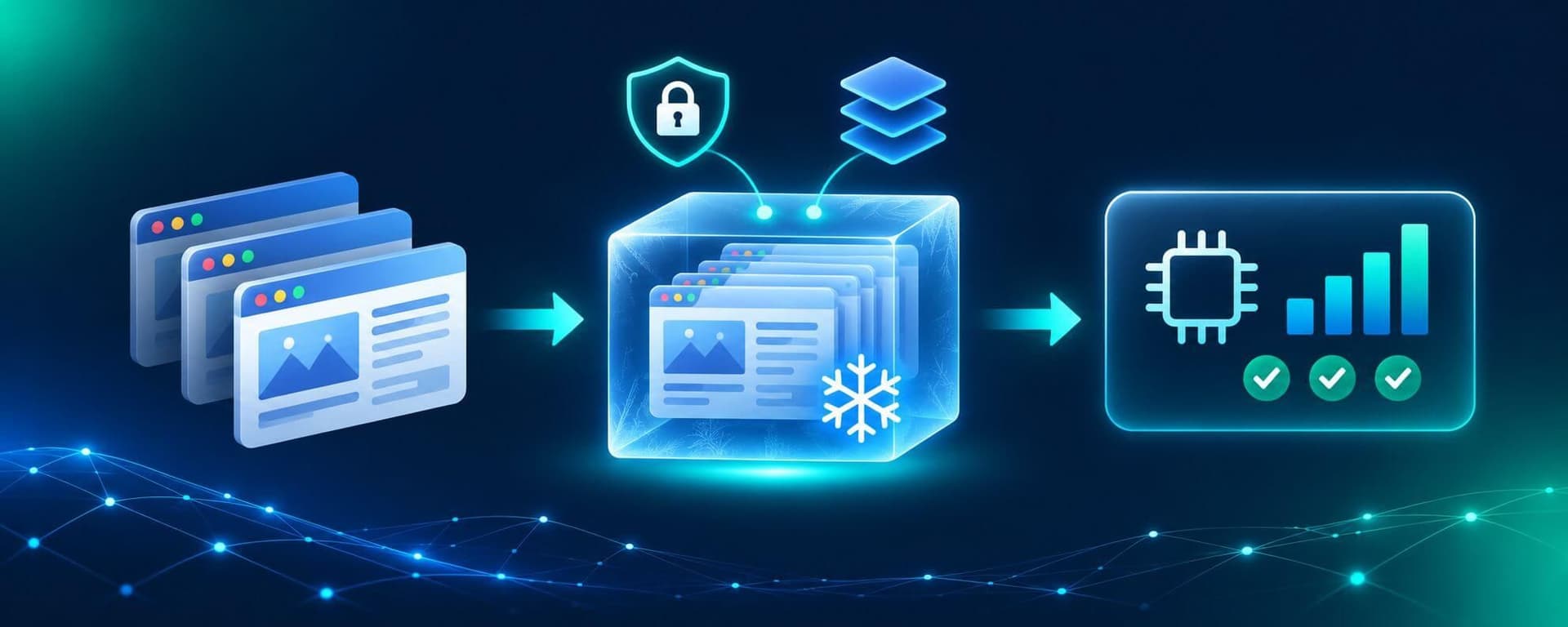
AI evaluations require controlled evidence. When benchmarks download live webpages on every run, apparent model gains or regressions may actually reflect changed or missing sources.
A reproducible web dataset snapshot is a versioned collection of captured web responses, extracted records, provenance metadata, and evaluation definitions that can be verified and replayed without fetching the live web again. It preserves what the evaluation system could observe at a defined time, not what the website looks like today.
This guide explains the pipeline for retrieval-augmented generation (RAG), information extraction, and search evaluation.
Webpages change prices, documentation, and news. JavaScript applications may vary content by cookie, location, or time—even at an unchanged URL.
These changes create three distinct risks:
A fixed random seed cannot correct any of these problems. Reproducibility requires retaining the exact evaluation inputs and documenting how they were created. It does not guarantee identical future crawls.
A list of URLs is not a dataset snapshot. The URL is a reference to a changing resource, not a preserved observation.
| Component | What to retain | Why it matters |
|---|---|---|
| Source capture | Response body, HTTP status, relevant headers, final URL, capture time | Establishes what was retrieved |
| Provenance | Original URL, crawl configuration, permitted source, region, user agent | Explains collection conditions |
| Integrity | SHA-256 digest and immutable object path | Detects accidental modification |
| Transformation | Parser version, normalization rules, extracted text | Makes processing repeatable |
| Evaluation | Questions, labels, splits, metrics, scoring version | Keeps model comparisons fair |
| Release metadata | Snapshot ID, manifest, code commit, dataset card | Allows audits and rollback |
Store raw captures separately from cleaned text. Otherwise, a later parser improvement may silently replace the evidence used in an earlier benchmark.
Define the benchmark decision first. RAG tests might use a documentation release; extraction tests might use product specifications from one collection window.
Specify the allowed domains, URL inclusion rules, target language, time window, document types, evaluation tasks, and exclusion criteria. Set crawl-depth and URL budgets. Distinguish historical accuracy, freshness, and regional variation.
Do not mix these objectives. A fixed historical snapshot is suitable for regression testing; a regularly refreshed benchmark measures performance against newer information. Both are useful, but their scores should be reported separately.
Only collect material you are authorized to access. Check source terms, licensing, privacy obligations, and applicable access restrictions. Honor robots.txt rules using the Robots Exclusion Protocol, RFC 9309, while recognizing that robots rules are not themselves permission to reuse or redistribute content.
Apply per-host concurrency limits, conservative request rates, bounded retries, and explicit timeouts. Respect HTTP 429 responses and Retry-After values. Use a predictable queue.
Record request headers affecting representations, including Accept-Language, plus relevant cookies or authentication state where permitted. Never publish access tokens or personal session data in the manifest. For operational crawl controls, see how to crawl a website without getting blocked.
For archival-quality capture, consider WARC (Web ARChive). ISO 28500:2017 defines a format that can preserve response content, protocol information, metadata, and associated records. Common Crawl distinguishes WARC raw records, WAT metadata, and WET extracted text—an instructive separation for AI data pipelines.
For simple static pages, archived response bodies and a manifest may be sufficient. For JavaScript-heavy pages, capture the rendered DOM and necessary assets with a controlled browser version. Log viewport, locale, timezone, and rendering completion criteria. Screenshots support visual checks but cannot replace source records.
Keep unsuccessful responses as crawl events. A timeout, redirect, or 403 must not silently become an empty evaluation document.
Compute SHA-256 over each stored payload and save it under a content-derived identifier. If two captures have identical payload bytes, they can reference the same object while retaining distinct URL-level provenance records.
A useful JSON Lines manifest contains source_url, captured_at_utc, status_code, content_type, payload_sha256, object_path, collector_version, and snapshot_id. Add redirect history and representation-affecting headers when applicable. Hashes verify bytes, not truthfulness or reuse rights.
Sort manifest records by a defined key and publish a checksum of the completed manifest. Treat finalized releases as immutable: corrections produce a new snapshot version rather than rewriting the old one.
Define a fixed HTML-to-text pipeline, including boilerplate removal, Unicode normalization, table handling, duplicate detection, and chunk boundaries. Pin dependencies and any browser or tokenizer versions that affect output.
Keep separate capture hashes and derived-record hashes. Different HTML can yield identical text; parser upgrades can change extracted text.
Do not automatically strip dates, numbers, or attribution merely because they appear in page templates. Those fields may be the facts your evaluation is designed to test. Review representative records manually before freezing extraction rules.
For RAG, store source-document IDs alongside each question and reference answer. Preserve the retrieval corpus, chunking settings, index build configuration, scoring rubric, and any human adjudications. Keep training and development examples separate from the final test set.
Check for exact and near-duplicate documents, syndicated content, repeated question templates, and answer leakage across splits. Temporal evaluation requires additional care: a question about information available in March should not be judged against a page first published in June unless the test explicitly examines hindsight.
Document gaps, domain imbalance, and uncertain labels. A snapshot can be perfectly reproducible yet still produce misleading evaluation results if its sampling is unrepresentative.
Package the archived objects, manifest, extracted records, evaluation files, configuration, and quality report under one immutable release ID. Record the Git commit, container image digest, dependency lockfile, and evaluation software version.
DVC tracks large data artifacts alongside code. If you distribute datasets through Hugging Face, pin a dataset repository commit SHA using its revision parameter instead of relying on a moving main branch. Publish a dataset card covering intended uses, collection methods, limitations, and redistribution rights.
The following example shows the core storage pattern for a small, preapproved URL set. Install requests first. Compliance checks, rate limiting, redirect handling, streaming size limits, and error logging must be added before production use.
import hashlib
import json
from datetime import datetime, timezone
from pathlib import Path

import requests

urls = ["https://example.com/"]  # Preapproved sources only
snapshot_id = "2026-11-02-eval-v1"
root = Path("snapshots") / snapshot_id
objects = root / "objects"
objects.mkdir(parents=True, exist_ok=True)

with (root / "manifest.jsonl").open("w", encoding="utf-8") as out:
    for url in sorted(set(urls)):
        response = requests.get(
            url, timeout=(5, 20), allow_redirects=False
        )
        payload = response.content
        digest = hashlib.sha256(payload).hexdigest()
        (objects / digest).write_bytes(payload)

        record = {
            "snapshot_id": snapshot_id,
            "source_url": url,
            "captured_at_utc": datetime.now(timezone.utc).isoformat(),
            "status_code": response.status_code,
            "content_type": response.headers.get("Content-Type"),
            "payload_sha256": digest,
            "object_path": f"objects/{digest}",
        }
        out.write(json.dumps(record, sort_keys=True) + "\n")
Here, requests exposes the decoded response body rather than a byte-for-byte network transcript. Use WARC capture when complete HTTP exchange fidelity is required. A production implementation must also avoid rewriting existing release directories and record failed fetches rather than aborting without a complete audit trail.
Proxies can make large, permitted collection jobs easier to operate, but proxy stability and dataset reproducibility are different requirements. More IP addresses do not make a snapshot scientifically valid.
For public, permitted workloads, datacenter proxies can support distributed fetch workers and predictable network routing. Track the egress region and proxy assignment for every capture where responses may vary by geography. Do not rotate regions indiscriminately when the benchmark expects a single market or language.
Keep sessions stable when required; rotate IPs only when the workload justifies it. The proxy rotation and pool management guide explains workload-based strategies.
Monitor per-host error rates, timeouts, 429 responses, and valid-document yield. HTTP 200 can still return a soft-block page. The production proxy monitoring guide covers these operational signals.
For teams collecting public web material for evaluation, ProxiesThatWork describes relevant AI and training-data use cases and provides bulk HTTP/HTTPS datacenter proxy plans. Confirm that target access policies and required regions align with the chosen deployment before collecting.
A snapshot should fail publication when basic integrity or coverage checks fail. Use thresholds selected for the particular evaluation rather than arbitrary universal percentages.
| Gate | Practical validation |
|---|---|
| Integrity | Every payload checksum matches the manifest |
| Coverage | Actual URL and domain counts meet the approved plan |
| Content validity | Captured documents are not mostly errors or challenge pages |
| Extraction | Representative text, dates, and tables survive parsing |
| Evaluation leakage | Duplicates and train/test overlap are reviewed |
| Replay | A clean environment reproduces the same dataset records |
An evaluation runner should read the frozen dataset from storage, verify checksums, rebuild its index using pinned settings, and execute a versioned set of questions and scoring rules. Log the model identifier, prompt template, generation parameters, retrieval configuration, run timestamp, and metrics.
Even with fixed inputs, inference can be nondeterministic and hosted models can change. Reproducibility means inspectable inputs, procedures, and provenance, not identical generated words.
To test freshness, create a new snapshot and compare it against the previous release. Report score changes alongside dataset changes; otherwise, source drift may be mistaken for model improvement.
It is a frozen, versioned collection of web captures, extracted data, metadata, and test definitions used to evaluate an AI system against consistent evidence.
Usually not. Without source URLs, timestamps, archived responses, extraction versions, and checksums, it may be impossible to explain or reproduce how the CSV was created.
They serve different purposes. WARC preserves web captures and protocol context; JSONL is convenient for manifests and model-ready examples. Many reliable pipelines use both.
No. ETag and Last-Modified support HTTP cache validation under RFC 9110. They are not replacements for storing content and computing your own integrity hashes.
Match the cadence to the evaluation goal. Use a frozen release for regression comparisons and separate scheduled releases for measuring freshness or changing web conditions.
No. Proxies affect network access and potentially regional responses. Drift prevention comes from archiving the actual responses, fixing transformation rules, recording collection conditions, and versioning the benchmark.
A reliable AI benchmark starts with reliable evidence. Define the evaluation contract, capture permitted pages with full provenance, preserve raw responses, hash every artifact, pin transformations, and freeze the questions and scoring rules. Once the release is immutable, model comparisons become easier to audit—and changes in the live web no longer silently rewrite yesterday's benchmark.
Jesse Lewis is a researcher and content contributor for ProxiesThatWork, covering compliance trends, data governance, and the evolving relationship between AI and proxy technologies. He focuses on helping businesses stay compliant while deploying efficient, scalable data-collection pipelines.