

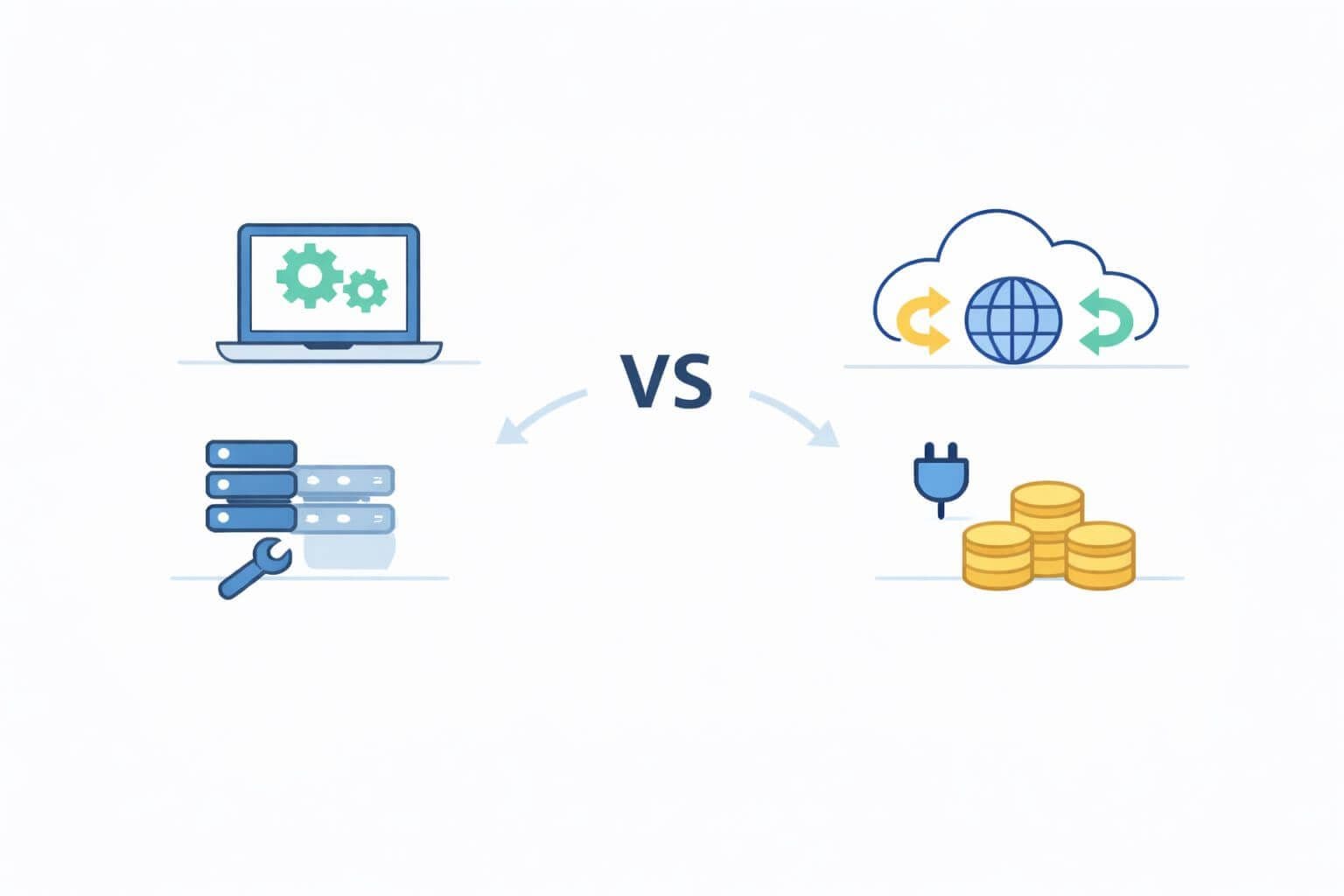
Rotating IP addresses is a core part of reliable web scraping, ad verification, price monitoring, SEO data collection, and large-scale application testing. A well-designed rotation strategy distributes requests across multiple IPs, reduces repeated exposure of individual addresses, and helps maintain stable sessions where needed.
Poorly configured rotation can have the opposite effect. Excessive IP changes, weak health monitoring, or aggressive retry behavior can increase block rates, introduce inconsistent data, and raise infrastructure costs.
Most production teams use one of two approaches:
The better choice depends on how much control you need, how difficult your target sites are, the engineering resources available, and the cost of failed requests.
Proxy rotation is the process of changing the proxy IP used for outbound requests according to predefined rules.
Rotation does not necessarily mean assigning a new IP to every request. Production systems usually choose a strategy based on the behavior of the target website and the workflow being automated.
Common rotation methods include:
The goal is not simply to rotate frequently. It is to match IP persistence, request rate, concurrency, and pool size to the behavior of the target.
Teams implementing their own rotation logic can use a dedicated proxy rotation workflow in Python to separate proxy selection, retries, session handling, and health monitoring from the rest of the scraper.
Scripted rotation means your application or infrastructure controls how proxies are selected and used.
You may maintain a pool of datacenter, ISP, residential, or other proxy types and assign them through application logic, a proxy manager, a load balancer, or another routing layer.
A typical scripted proxy system needs to:
At larger scale, these functions become part of a broader scalable proxy pool architecture that manages allocation, health scoring, concurrency, and replacement continuously.
Maximum control
Teams can define rotation policies for individual domains, workflows, countries, applications, or traffic classes.
Flexible routing logic
Proxy selection can incorporate custom signals such as latency, geography, historical success rate, target-specific block rates, or available capacity.
Potentially lower infrastructure cost
Large datacenter proxy pools can provide favorable economics when traffic volume is predictable and the organization already has the engineering resources required to operate them.
Better integration with custom systems
Rotation can be closely connected with job queues, retry systems, observability platforms, crawlers, and data pipelines.
Ongoing engineering work
Proxy health checking, retries, cooldown rules, telemetry, session management, and replacement logic require continuous maintenance.
Operational complexity
Failures can originate from DNS, TLS, network connectivity, proxy authentication, target websites, IP reputation, or application behavior.
Greater monitoring requirements
Without reliable observability, unhealthy proxies can remain in circulation and reduce the overall success rate of the pool.
Specialized expertise
Operating proxy infrastructure at scale requires knowledge of networking, request behavior, concurrency management, rate limiting, and target-specific defenses.
Scripted rotation is usually a good fit when:
Managed proxy rotation delegates IP selection and pool maintenance to a proxy provider.
Instead of connecting directly to individual proxy IPs, the application typically connects to a gateway. The provider decides which proxy should handle each request according to parameters such as location, session identifier, pool type, or rotation policy.
A managed proxy service may provide:
Some services also provide additional scraping infrastructure such as browser automation, CAPTCHA handling, or target-specific request routing.
Teams evaluating these systems should compare the capabilities of managed proxy platforms and proxy managers, since features such as session controls, routing transparency, monitoring, and pool access vary considerably between implementations.
Fast deployment
Developers generally integrate one endpoint instead of building an entire proxy management system.
Automatic pool maintenance
Unhealthy or unavailable proxies can be removed from circulation without changes to application code.
Elastic capacity
Managed networks are often easier to scale when traffic fluctuates significantly.
Simpler session management
Sticky sessions can often be controlled using usernames, tokens, ports, or session parameters.
Provider support
Commercial services may include dashboards, technical support, service-level commitments, and usage analytics.
Higher unit cost
Residential, mobile, and managed scraping networks may charge substantially more per gigabyte or successful request than basic datacenter proxy infrastructure.
Limited visibility
Customers may have little information about how individual IPs are selected, scored, cooled, or replaced.
Provider dependency
Routing behavior, pricing, network availability, and product capabilities depend on the provider.
Performance variation
Different providers can produce very different results on the same target because pool composition, routing infrastructure, and IP reputation vary.
Managed rotation is usually better when:
| Factor | Scripted Rotation | Managed Rotation |
|---|---|---|
| Setup complexity | Higher | Lower |
| Rotation control | Very high | Provider-dependent |
| Maintenance | Internal team | Mostly provider |
| Pool transparency | High | Often limited |
| Scaling | Requires capacity planning | Usually elastic |
| Monitoring | Must be built | Often included |
| Unit infrastructure cost | Potentially lower | Usually higher |
| Engineering cost | Higher | Lower |
| Vendor dependency | Lower | Higher |
| Best suited for | Predictable, controlled workloads | Fast-moving or difficult workloads |
Neither model is universally better. The more useful comparison is cost per successful request, including infrastructure and engineering overhead.
Scripted systems can minimize routing overhead when proxies are located close to target infrastructure and traffic paths are carefully controlled.
Managed gateways introduce another routing layer, but they may provide more consistent performance because load balancing and unhealthy-node removal are handled automatically.
For production workloads, median latency alone is not enough. Monitor latency percentiles such as p95 and p99 to identify intermittent network degradation.
Managed networks often maintain relatively stable performance during sudden traffic increases because pool capacity and replacement are handled by the provider.
A well-engineered scripted pool can achieve similar results, but only when health checks, cooldowns, retry policies, and proxy replacement are continuously maintained.
Both approaches can support persistent sessions.
Managed systems typically use a session identifier or sticky-session parameter. Scripted systems must maintain their own mapping between sessions, proxies, cookies, and expiration rules.
Changing IP addresses alone does not make automated traffic indistinguishable from normal browser traffic.
Websites may evaluate many additional signals, including:
Changing IPs unnecessarily can create inconsistent behavior.
For example, switching addresses during a multi-step login or checkout workflow can cause session validation problems. Some websites may also treat frequent identity changes as suspicious.
Sticky sessions are generally more appropriate when several requests belong to the same logical user journey.
A stronger strategy adjusts behavior when failure signals appear.
Examples include:
These techniques can also reduce the likelihood of repeatedly sending traffic through addresses with deteriorating reputation. A broader IP blacklisting prevention strategy should combine rotation with rate control, health scoring, and responsible request behavior.
Proxy rotation should be treated as measurable infrastructure rather than a simple IP-switching function.
At minimum, monitor:
These metrics make it possible to determine whether failures originate from the proxy network, the target, or the application itself.
Managed platforms may expose some of these measurements through dashboards or APIs. Scripted systems usually require an internal monitoring pipeline.
The cheapest proxy configuration is not necessarily the configuration with the lowest proxy price.
A better metric is:
Total proxy cost ÷ successful requests
Scripted infrastructure may include:
The proxy itself may be inexpensive, while operational costs remain significant.
Managed services generally charge more for network access but reduce the amount of infrastructure the customer operates directly.
Their cost may include:
Comparing proxy pricing and infrastructure economics is therefore most useful when bandwidth price, success rate, developer time, and operational overhead are evaluated together.
Proxy architecture also affects security.
Store proxy usernames, passwords, and tokens in a secrets-management system rather than directly in source code.
Rotate credentials periodically and restrict access where supported.
Avoid storing sensitive request bodies, authentication tokens, personal information, or full payloads unless they are genuinely required for debugging.
Where possible, proxy infrastructure should only be permitted to connect to approved destinations. This reduces the risk of accidental misuse or unauthorized data transfer.
Organizations using third-party proxy networks should understand how IP addresses are obtained and whether the network's operating model aligns with their compliance requirements.
Questions around consent, network sourcing, privacy, and acceptable use are covered in more detail in our guide to proxy consent and data ethics.
Many production systems eventually use both approaches.
A hybrid architecture can route different workloads through different proxy systems based on difficulty, cost, or reliability requirements.
For example:
This approach prevents teams from paying premium managed-proxy rates for every request while preserving access to more flexible infrastructure when necessary.
Avoid embedding provider-specific logic throughout the application.
Instead, expose a small interface that controls variables such as:
This makes it easier to switch between providers or migrate workloads to an internally managed pool.
Do not move an entire workload at once.
Route a small percentage of traffic through the new system and compare:
Increase traffic gradually once the new configuration performs reliably.
Use the same error classifications and performance metrics across both systems.
Without consistent telemetry, comparisons between scripted and managed rotation become misleading.
Per-request rotation is not automatically better. Session-based applications often need a stable IP for several requests.
Repeatedly retrying after rate-limit responses can make the problem worse.
Respect server-provided Retry-After instructions where applicable and reduce request frequency.
An IP that begins generating repeated failures should usually enter a cooldown period rather than returning directly to circulation.
Different websites behave differently.
Concurrency, session length, rotation frequency, request headers, and retry behavior should be configured per target where practical.
A cheaper proxy pool may become more expensive overall if it generates substantially more retries and failures.
Before choosing a rotation architecture, define:
Not always. Per-request rotation provides high IP diversity but can disrupt workflows that depend on cookies or session continuity. Sticky sessions are usually better for multi-step interactions.
They can reduce operational complexity because the provider maintains the proxy pool and removes unhealthy nodes. Reliability still varies significantly between providers, networks, locations, and target websites.
The proxy infrastructure itself may be cheaper, particularly with datacenter IPs. However, engineering, monitoring, maintenance, failover, and operational costs must also be included.
Yes. Datacenter proxies can be rotated using application logic, proxy-management software, or a provider-operated gateway. They are often attractive for high-volume workloads because bandwidth and IP costs can be lower than residential networks.
A sticky session keeps the same proxy IP assigned to a logical session for a defined period or number of requests. It is useful when a workflow requires consistent cookies, authentication, or geographic identity.
Important metrics include request success rate, HTTP 403 and 429 responses, latency percentiles, timeout rate, CAPTCHA frequency, proxy utilization, session duration, and cost per successful request.
Scripted proxy rotation provides maximum control and can produce attractive economics at scale, but the organization becomes responsible for proxy health, session management, retries, observability, and pool maintenance.
Managed rotation reduces that operational burden by placing pool management behind a gateway, although customers typically pay more for the convenience, network diversity, and elasticity.
For many production environments, the best architecture is hybrid: use inexpensive, controlled proxy infrastructure for predictable workloads and managed networks where additional resilience or IP diversity justifies the higher cost.
Whichever model you choose, evaluate it using measurable outcomes such as success rate, latency, block rate, and cost per successful request. Proxy rotation works best when it is treated as an actively monitored infrastructure system rather than a static configuration.
Ed Smith is a technical researcher and content strategist at ProxiesThatWork, specializing in web data extraction, proxy infrastructure, and automation frameworks. With years of hands-on experience testing scraping tools, rotating proxy networks, and anti-bot bypass techniques, Ed creates clear, actionable guides that help developers build reliable, compliant, and scalable data pipelines.