

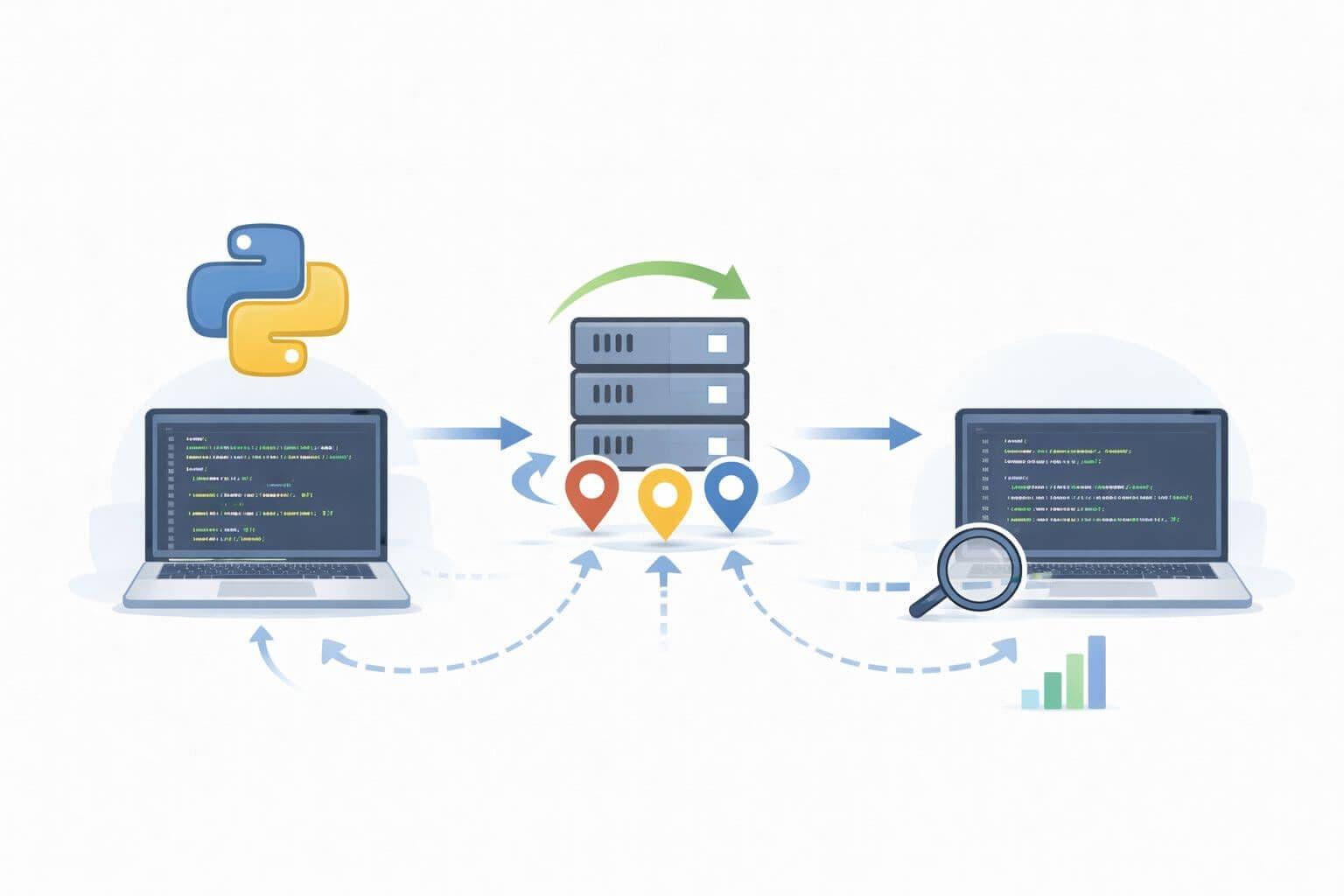
Python has become the default language for automation: web scraping, monitoring, ETL jobs, SEO tools, and AI data ingestion pipelines. As soon as those workloads grow beyond a few hundred requests a day, proxies stop being an optional “nice to have” and become core infrastructure.
This guide walks through practical Python proxy patterns for large-scale automation:
All examples assume you’re using datacenter or dedicated proxies from a reputable provider and that your use cases are legal and compliant.
Python’s ecosystem makes it easy to bolt proxies into your stack:
Proxies in this context help you:
At small scale, a single proxy endpoint is fine. At large scale, you need patterns, not one-off snippets.
Before jumping to code, clarify three core ideas.
A proxy pool is a managed collection of proxy endpoints:
protocol://user:pass@host:port strings You almost never want “one big global pool” for everything. Segmenting pools lets you tune behavior per target or per customer.
Proxy rotation defines how and when you switch between IPs:
Good rotation patterns avoid hammering the same IP and also avoid over-rotating unnecessarily (which can look suspicious on login flows).
Different targets have different tolerance:
You’ll want per-target settings for:
Think of each target as having its own profile.
This is the simplest useful pattern: a pool of proxies, a round-robin index, and a helper function.
import itertools
import random
import time
import requests
PROXIES = [
"http://user:pass@proxy1.example.com:8000",
"http://user:pass@proxy2.example.com:8000",
"http://user:pass@proxy3.example.com:8000",
]
proxy_cycle = itertools.cycle(PROXIES)
def get_next_proxy():
proxy_url = next(proxy_cycle)
return {
"http": proxy_url,
"https": proxy_url,
}
def fetch(url, timeout=15):
proxies = get_next_proxy()
headers = {
"User-Agent": "Mozilla/5.0 (compatible; PTWBot/1.0; +python-proxy-patterns)"
}
resp = requests.get(url, headers=headers, proxies=proxies, timeout=timeout)
resp.raise_for_status()
return resp
This alone gives you:
Limitations:
Still, it’s a good first step.
At scale, you want to penalize bad proxies and retry with better ones.
import time
import random
import requests
from collections import defaultdict
PROXIES = [
"http://user:pass@proxy1.example.com:8000",
"http://user:pass@proxy2.example.com:8000",
"http://user:pass@proxy3.example.com:8000",
]
health = defaultdict(lambda: {"failures": 0, "last_failure": 0})
def select_proxy():
# Simple weighting: sort by fewest failures and oldest last_failure
sorted_proxies = sorted(
PROXIES,
key=lambda p: (health[p]["failures"], health[p]["last_failure"])
)
# pick one of the top two to add a bit of randomness
candidate = random.choice(sorted_proxies[:2])
return candidate
def mark_failure(proxy_url):
health[proxy_url]["failures"] += 1
health[proxy_url]["last_failure"] = time.time()
def mark_success(proxy_url):
# Gradually forgive past failures
health[proxy_url]["failures"] = max(0, health[proxy_url]["failures"] - 1)
def fetch_with_retry(url, max_attempts=5, timeout=15):
last_error = None
for attempt in range(1, max_attempts + 1):
proxy_url = select_proxy()
proxies = {"http": proxy_url, "https": proxy_url}
try:
resp = requests.get(url, proxies=proxies, timeout=timeout)
if resp.status_code in (403, 429, 500, 502, 503, 504):
mark_failure(proxy_url)
last_error = f"Bad status {resp.status_code}"
else:
mark_success(proxy_url)
return resp
except requests.RequestException as e:
mark_failure(proxy_url)
last_error = str(e)
sleep_time = min(2 ** attempt, 30)
time.sleep(sleep_time)
raise RuntimeError(f"All proxy attempts failed: {last_error}")
This pattern adds:
You can extend health with rolling success rates, last latency, or target-specific performance.
When you need tens of thousands of requests per minute, async is almost mandatory.
import asyncio
import httpx
import random
PROXIES = [
"http://user:pass@proxy1.example.com:8000",
"http://user:pass@proxy2.example.com:8000",
"http://user:pass@proxy3.example.com:8000",
]
async def fetch(client, url):
proxy = random.choice(PROXIES)
try:
resp = await client.get(url, proxies=proxy, timeout=15.0)
resp.raise_for_status()
return resp.text
except httpx.HTTPError as e:
# log and handle
return None
async def main(urls):
async with httpx.AsyncClient() as client:
tasks = [fetch(client, url) for url in urls]
results = await asyncio.gather(*tasks)
return results
# asyncio.run(main(list_of_urls))
import asyncio
import aiohttp
import random
PROXIES = [
"http://user:pass@proxy1.example.com:8000",
"http://user:pass@proxy2.example.com:8000",
"http://user:pass@proxy3.example.com:8000",
]
async def fetch(session, url):
proxy = random.choice(PROXIES)
try:
async with session.get(url, proxy=proxy, timeout=15) as resp:
if resp.status in (403, 429):
# log block
return None
return await resp.text()
except Exception:
# log failure
return None
async def run(urls, max_concurrency=50):
sem = asyncio.Semaphore(max_concurrency)
async with aiohttp.ClientSession() as session:
async def bound_fetch(url):
async with sem:
return await fetch(session, url)
tasks = [bound_fetch(url) for url in urls]
return await asyncio.gather(*tasks)
Key ideas:
A single global config rarely works. One target might tolerate 200 concurrent requests; another will block at 5.
Design a simple per-target profile structure:
TARGET_PROFILES = {
"search_engine_x": {
"max_concurrency": 10,
"delay_ms": (500, 1500),
"status_retry": [429, 500, 502, 503],
"proxy_pool": "pool_search",
"user_agent": "Mozilla/5.0 ... SearchBot/1.0",
},
"ecommerce_y": {
"max_concurrency": 4,
"delay_ms": (1500, 3000),
"status_retry": [429],
"proxy_pool": "pool_ecom",
"user_agent": "Mozilla/5.0 ... PriceMonitor/1.0",
},
}
PROXY_POOLS = {
"pool_search": [...],
"pool_ecom": [...],
}
Then, in your job code:
This pattern makes it easy to onboard new sites and tweak behavior without rewriting your scraper core.
Sometimes a target is just having a bad time: maintenance, new bot rules, or temporary outages. Hammering it harder is wasteful and can hurt your IP reputation.
A circuit breaker pattern lets you pause traffic when error rates are high.
import time
from collections import deque
class CircuitBreaker:
def __init__(self, window_size=50, fail_threshold=0.5, cooldown=300):
self.window = deque(maxlen=window_size)
self.fail_threshold = fail_threshold
self.cooldown = cooldown
self.open_until = 0
def record(self, success: bool):
self.window.append(success)
if self.is_open():
return
if len(self.window) == self.window.maxlen:
fail_rate = 1 - sum(self.window) / len(self.window)
if fail_rate >= self.fail_threshold:
self.open_until = time.time() + self.cooldown
def is_open(self):
return time.time() < self.open_until
def time_remaining(self):
return max(0, int(self.open_until - time.time()))
# Usage per target:
breaker = CircuitBreaker()
def guarded_fetch(url):
if breaker.is_open():
raise RuntimeError(
f"Target temporarily disabled, retry after {breaker.time_remaining()}s"
)
try:
resp = fetch_with_retry(url) # your existing function
breaker.record(True)
return resp
except Exception:
breaker.record(False)
raise
Benefits:
Some providers give you a single hostname and handle rotation behind the scenes. You control rotation via:
Example with a session parameter in the username:
import requests
import uuid
GATEWAY_HOST = "gw.example.com"
PORT = 8000
def make_session():
session_id = uuid.uuid4().hex[:8]
username = f"user-session-{session_id}"
password = "your_password"
proxy = f"http://{username}:{password}@{GATEWAY_HOST}:{PORT}"
return {
"session_id": session_id,
"proxies": {"http": proxy, "https": proxy},
}
def fetch_with_sticky_session(url):
ctx = make_session()
s = requests.Session()
s.proxies.update(ctx["proxies"])
resp = s.get(url, timeout=15)
return resp
Use cases:
This pattern sits nicely alongside a regular rotation pattern for stateless endpoints.
At scale, “it’s failing sometimes” is not enough. You need observability.
Log at least:
Example lightweight log line:
log.info(
"request",
extra={
"target": target_name,
"status": resp.status_code,
"latency_ms": int(resp.elapsed.total_seconds() * 1000),
"proxy_id": proxy_label,
},
)
Then, build simple dashboards:
Patterns you might see:
Once you see the patterns, you can adjust:
No proxy pattern is worth it if it violates laws or terms of service.
Basic principles:
When in doubt, involve legal and compliance teams before scaling.
There is no single “best,” but patterns matter more than the library. For sync workloads, requests plus careful pooling and retries is often enough. For high-concurrency tasks, httpx or aiohttp are strong choices because they support async and efficient connection reuse. Many teams use both: requests for simple jobs and httpx or aiohttp for heavy pipelines.
It depends on concurrency, target strictness, and acceptable error rates. Light workloads may work fine with a few dozen IPs. Large-scale scraping against strict targets can require hundreds or thousands of IPs and multiple pools. A practical approach is to start with a small pool, measure success and block rates, then grow the pool and concurrency gradually until you hit your performance and reliability targets.
Not always. For stateless endpoints, per-request rotation is fine and often desirable. For flows involving logins, carts, or multi-step forms, use sticky sessions that keep the same IP for the duration of the workflow. Over-rotation can look suspicious when you appear to jump IPs every time you click “next” in a multi-step process.
Track per-proxy metrics like failure rate, average latency, and the distribution of status codes. If a specific IP consistently produces timeouts, 403s, or CAPTCHAs while others succeed, mark it as unhealthy, remove it from rotation, and optionally retry with a different proxy. Health-aware pools and simple scoring systems are usually enough to weed out bad IPs over time.
No. Rotating proxies are powerful when you need broad coverage and high request volume, but static private proxies can be more predictable and easier to allowlist for partners, APIs, or login-based flows. Mature Python automation stacks typically use both: rotating proxies for large-scale public scraping and static private proxies for stable, long-lived sessions and integrations.
Large-scale automation in Python is less about finding a magic library and more about composing the right patterns:
Once those patterns are in place, you can swap out providers or libraries with relatively little friction.
If you want a stable backbone for these patterns, look for developer-friendly dedicated datacenter proxies with clean IPs, predictable pricing, and simple authentication. That kind of foundation lets your Python pipeline focus on the data, not on constantly fighting infrastructure.

Ed Smith is a technical researcher and content strategist at ProxiesThatWork, specializing in web data extraction, proxy infrastructure, and automation frameworks. With years of hands-on experience testing scraping tools, rotating proxy networks, and anti-bot bypass techniques, Ed creates clear, actionable guides that help developers build reliable, compliant, and scalable data pipelines.